Alphabet Soup: Decoding Emerging Dermatology Therapies
He discussed how safety findings from patients with rheumatoid arthritis may not fully reflect the experiences of younger dermatology populations with different baseline comorbidities and cardiovascular risk factors.7
Among dermatologic patients, adverse events discussed included respiratory infections, herpes zoster, nausea, and acne.
“Do I talk about cardiovascular disease in oral JAK patients? Absolutely, because I’m not going to hide anything,” Butler said.
He emphasized that clinicians have a responsibility to explain potential risks while also helping patients understand how those risks apply to their individual circumstances.
“It’s our responsibility to say, hey, I’m going to walk with you. Here are the risks of any medication I’m going to give you,” Butler said.
The discussion reinforced the importance of appropriate pretreatment screening, laboratory monitoring, infection risk assessment, and shared decision-making when initiating targeted immunomodulatory therapies.
TYK2 and the Evolution of Selective Inhibition
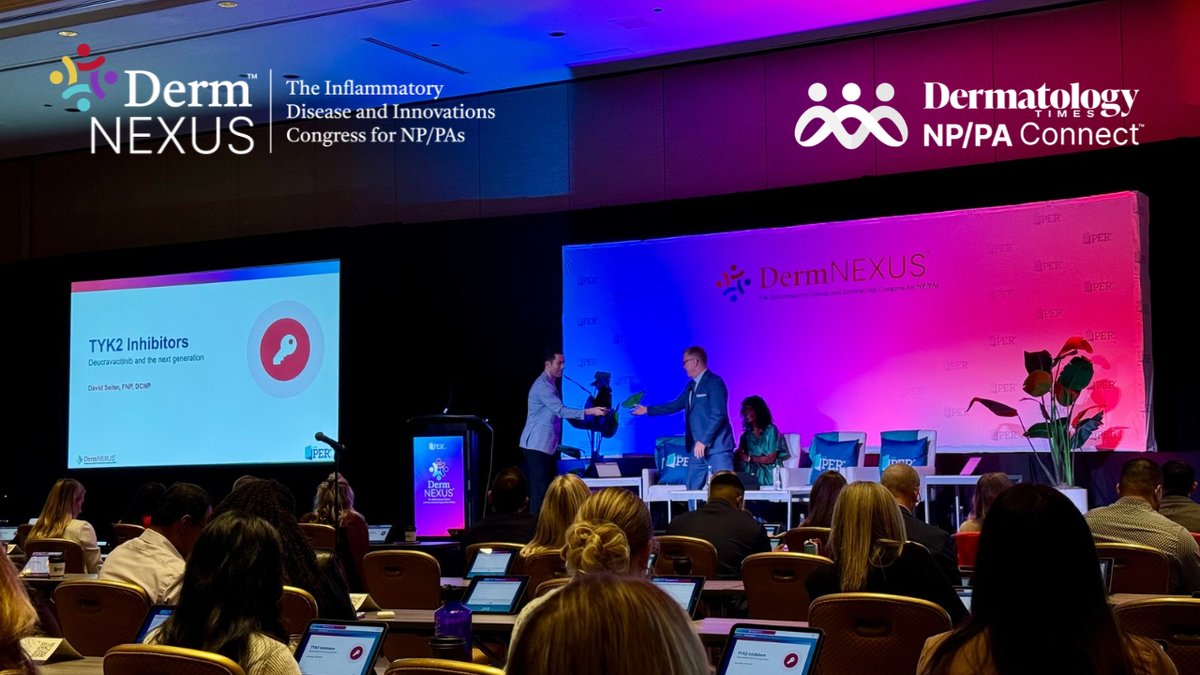
Seiter continued the mechanistic discussion by examining TYK2, a member of the JAK family involved in intracellular cytokine signaling.
Although TYK2 participates in related signaling processes,
The presentation highlighted how certain selective TYK2 inhibitors interact with a regulatory region of the enzyme rather than directly competing at its active site.
This distinction was presented as an example of how drug design and pathway selectivity can influence the development of new therapeutic approaches.
The discussion emphasized that clinicians should consider the specific mechanism of each treatment when interpreting clinical efficacy and safety findings.6
Faculty also acknowledged that newer targeted therapies require continued evaluation as longer-term clinical experience becomes available.
BTK Inhibition in Refractory Chronic Spontaneous Urticaria
The session also explored BTK inhibition as a treatment strategy for
BTK contributes to intracellular signaling involved in mast-cell activation, a central process in the development of urticaria symptoms, including wheals, itching, and angioedema.4
Aldredge presented a case involving a patient with persistent CSU despite previous treatment with
The patient’s continued disease burden prompted discussion of alternative treatment approaches, including BTK inhibition with
The case illustrated how understanding disease mechanisms can help clinicians identify therapeutic options when patients experience inadequate responses to multiple previous treatments.4
Faculty discussed
The discussion also addressed patient preferences, treatment adherence, and safety considerations, including potential bruising or bleeding, drug interactions, and management around procedures.5
Aldredge emphasized the importance of reassessing patients shortly after initiating treatment rather than waiting several months to evaluate their response.
The case demonstrated how targeted treatment selection should incorporate disease severity, prior treatment response, patient preferences, and ongoing monitoring.
Managing Psoriasis and Psoriatic Arthritis After Biologic Failure
A second clinical case examined a 44-year-old patient with longstanding psoriasis and PsA who continued to experience substantial disease activity despite multiple previous therapies.
The patient had a 20-year history of psoriasis, approximately 18% body surface area involvement, scalp and nail disease, and persistent joint symptoms, including swelling, tenderness, and dactylitis.3
Previous treatments included methotrexate and multiple biologic agents, yet the patient continued to experience significant skin and joint involvement.
The faculty discussed the potential role of JAK inhibition, including
During the case discussion, Seiter highlighted the potential advantages of targeting intracellular signaling pathways rather than focusing exclusively on individual inflammatory mediators.3
He explained that intracellular inhibition may affect signaling from multiple inflammatory pathways, potentially offering an alternative approach when highly targeted treatments have not adequately controlled disease.
Aldredge also emphasized the importance of evaluating the patient’s complete clinical profile when considering treatment options.
In this case, the patient’s relatively favorable cardiovascular risk profile, absence of smoking history, and lack of previous venous thromboembolism or malignancy contributed to the discussion of treatment suitability.7
Faculty reviewed evidence supporting upadacitinib in biologic-experienced patients with PsA, including improvements in joint symptoms and cutaneous disease.
Additional considerations included vaccination status, pregnancy planning, laboratory monitoring, and collaboration with rheumatology.
The case reinforced the importance of selecting therapies that address the full burden of psoriatic disease rather than focusing exclusively on skin manifestations.
Screening, Monitoring, and Shared Decision-Making
Throughout the session, the presenters reinforced the importance of appropriate pretreatment evaluation and ongoing monitoring when prescribing targeted immunomodulatory therapies.
The speakers also addressed infection screening, laboratory assessments, and follow-up monitoring, particularly when initiating JAK inhibitors and other targeted therapies.
Butler emphasized that clinicians should remain transparent about potential adverse effects while helping patients understand their individual risk profiles.
The discussion also highlighted the importance of documenting clinical reasoning, reviewing treatment expectations, and maintaining communication with patients throughout therapy.4
Across all therapeutic classes, faculty encouraged clinicians to consider not only the mechanism and efficacy of a treatment but also the patient’s comorbidities, treatment history, lifestyle, and preferences.
Translating Immunology Into Clinical Practice
As the session concluded, the presenters returned to the importance of understanding immunologic mechanisms as a foundation for clinical decision-making.4
Although OX40, JAK, TYK2, and BTK represent distinct therapeutic targets, their clinical relevance extends beyond their individual pathways. Understanding their roles in immune signaling can help clinicians interpret efficacy and safety findings, evaluate emerging treatment options, and individualize care.
The case presentations involving refractory CSU and biologic-experienced PsA demonstrated how pathway-based reasoning can be applied to real-world treatment decisions.
Faculty also emphasized that investigational therapies can contribute valuable scientific insights even when individual drug candidates do not ultimately reach the market.
The opening DermNexus 2026 session reinforced the importance of moving beyond the terminology of the “alphabet soup” to understand how increasingly complex immunologic science translates into practical, patient-centered dermatologic care.7
References
- Guttman-Yassky E, Croft M, Geng B, et al. The role of OX40 ligand/OX40 axis signalling in atopic dermatitis. Br J Dermatol. 2024;191(4):488-496.
https://doi.org/10.1093/bjd/ljae230 - Valenzuela F, Meza V. OX40/OX40L as a therapeutic target in atopic dermatitis: A scoping review. Biologics. 2025;19:281-288.
https://doi.org/10.2147/BTT.S511125 - Mease PJ, Lertratanakul A, Anderson JK, et al. Upadacitinib for psoriatic arthritis refractory to biologics: SELECT-PsA 2. Ann Rheum Dis. 2021;80(3):312-320.
https://doi.org/10.1136/annrheumdis-2020-218870 - US Food and Drug Administration. RHAPSIDO (remibrutinib) tablets: Prescribing information. Revised October 2026.
https://www.accessdata.fda.gov/drugsatfda_docs/label/2026/218436s001lbl.pdf - Metz M, Giménez-Arnau A, Hide M, et al. Remibrutinib in chronic spontaneous urticaria. N Engl J Med. 2025;392:984-994.
https://doi.org/10.1056/NEJMoa2408792 - Armstrong AW, et al. Deucravacitinib versus placebo and apremilast in moderate to severe plaque psoriasis: Efficacy and safety results from the phase 3 POETYK PSO-1 trial. J Am Acad Dermatol. 2023.
https://pubmed.ncbi.nlm.nih.gov/35820547/ - US Food and Drug Administration. RINVOQ (upadacitinib): Prescribing information. 2025.
https://www.accessdata.fda.gov/drugsatfda_docs/label/2025/211675s025lbl.pdf