Blancpain Introduces the World’s First Carrousel Incliné
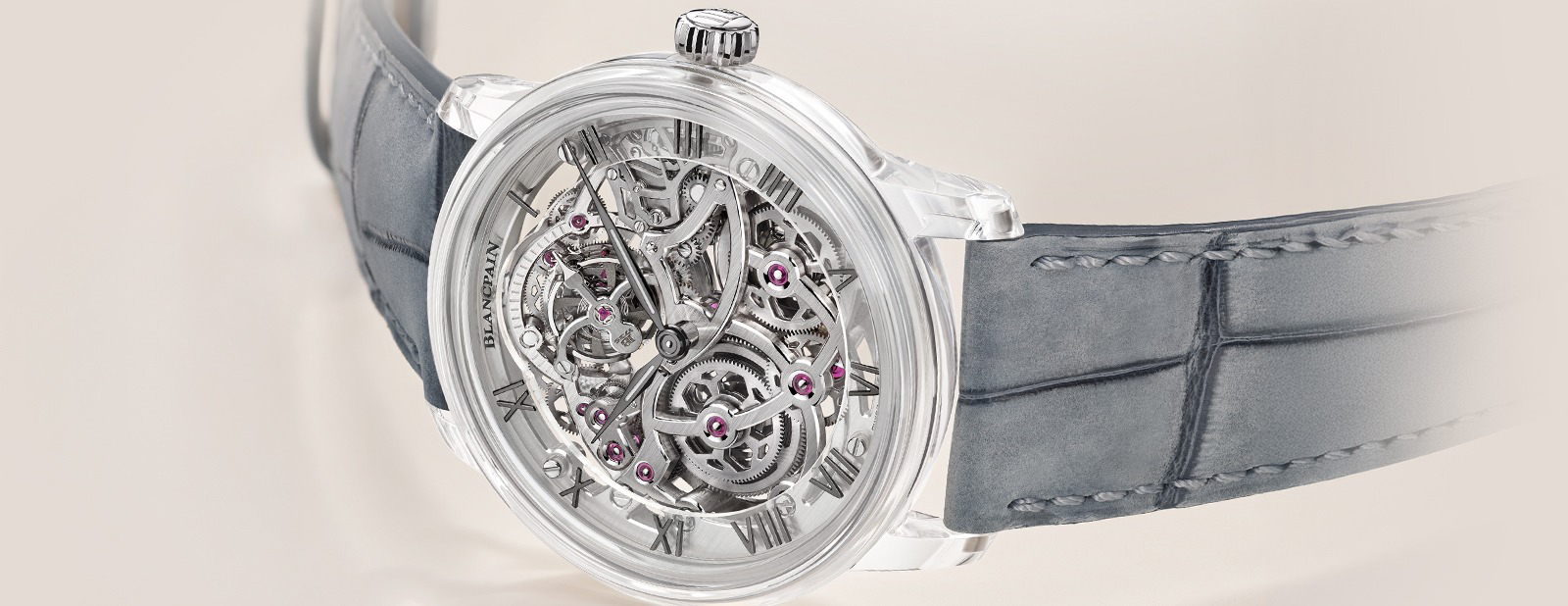
This time last year Blancpain unveiled the Double Grande Sonnerie, a truly remarkable, highly complicated timepiece that broke new ground on several fronts. It was also a reminder that innovation in complicated watchmaking has been foundational to the identity of modern Blancpain. This year the manufacture returns to a mechanism over which it enjoys something close to a monopoly – the one-minute flying carrousel.
Patented in England in 1892 by Danish watchmaker Bahne Bonniksen, the carrousel was conceived as a more robust and practical alternative to the tourbillon, doing away with the fixed wheel and having a much more leisurely period of rotation, typically 34 or 52.5 minutes. The carrousel enjoyed considerable success in the Kew Observatory trials, and movements supplied by Bonniksen were completed by watchmakers in Coventry, London and elsewhere. Production, however, dwindled with the decline of British watchmaking. Blancpain revived it in 2008 with the Carrousel Volant Une Minute, the first carrousel wristwatch. It had a flying cage with a centrally positioned balance and a one-minute rotation. It was later combined with other complications, including a cathedral minute repeater in 2010 and a minute repeater with a flyback chronograph in 2013. That same year, Blancpain brought a tourbillon and a carrousel together in a single watch, with a differential that averaged their rates.
Blancpain Villeret Tourbillon Carrousel launched in 2013. Set side by side, the two mechanisms offer a powerful visual comparison, with their distinct kinematics laid bare as parallel philosophies in the struggle with gravity
The new Carrousel Incliné takes a more holistic approach to chronometric improvement. Its cage at 12 o’clock is inclined at 30 degrees to the mainplate, an angle selected after extensive testing. As with inclined tourbillons, the aim is to reduce rate differences between horizontal and vertical positions by extending positional averaging to when the watch lies flat, where a conventional carrousel offers limited benefit. Blancpain assessed inclinations from 0 to 35 degrees in five-degree increments, recording rate, amplitude and maximum rate variation across the six standard positions at each step. It then settled on 30 degrees as the best compromise between rate stability and movement thickness.
Each watch is accompanied by an individual chronometry certificate issued by Blancpain, guaranteeing an impressive mean daily rate of 0/+2 seconds. Rate measurements are taken over one minute in each of six positions, two horizontal and four vertical, with the cycle repeated continuously throughout the 100-hour power reserve. The resulting record documents variations in rate as a function of position and state of wind.
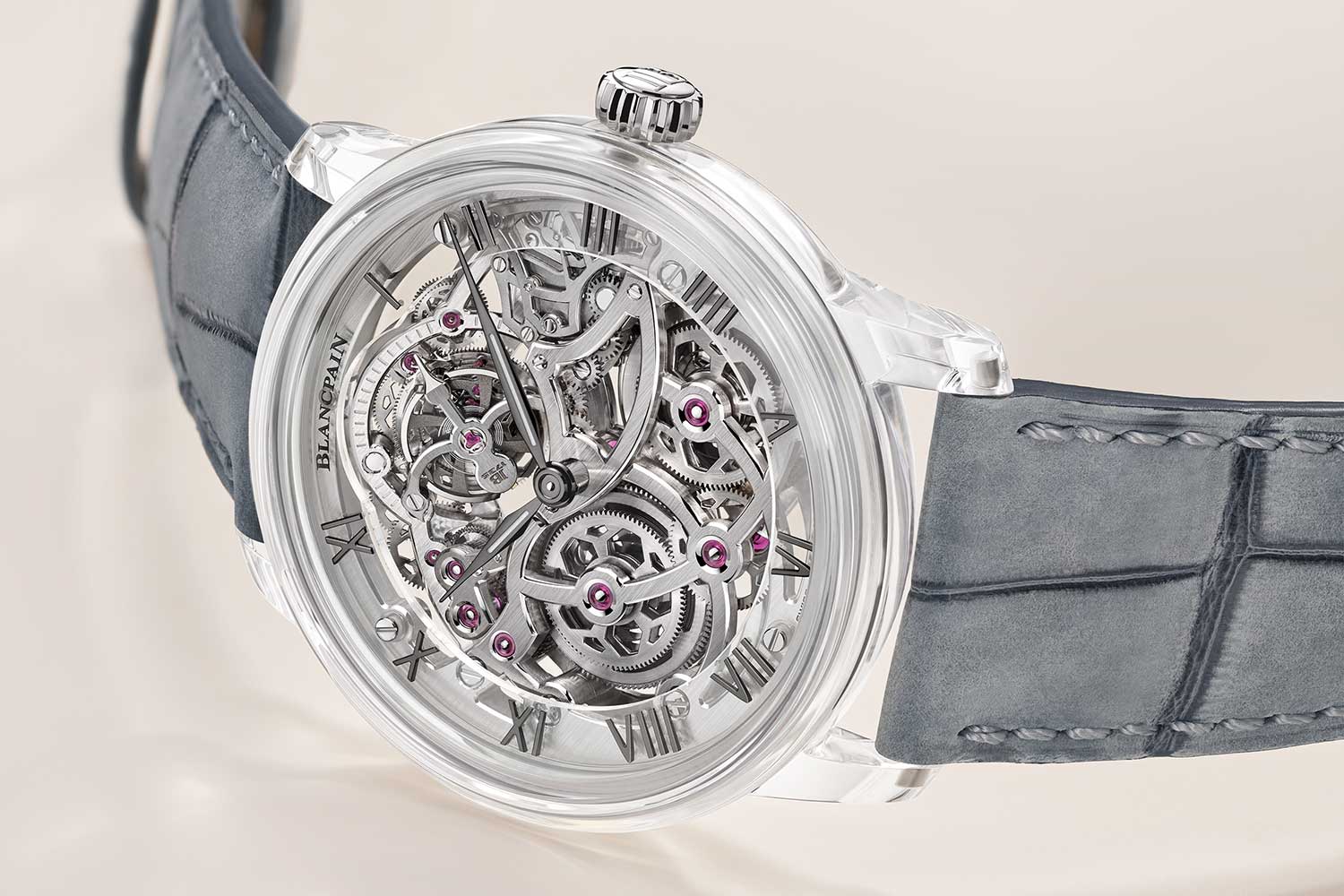
Blancpain Carrousel Incliné
The mechanism is housed in an openworked 18k gold movement within Blancpain’s first sapphire case, measuring 40.3mm in diameter and just 11.3mm thick. These proportions make it extremely wearable, particularly for a watch with an inclined regulating organ. It is among the slimmest cases to be produced entirely in sapphire. There are no screws. It comprises three parts, with the caseback and middle permanently bonded together with adhesive, while the bezel is retained by a compressed gasket and can be removed to access the movement from above. Despite the all-sapphire construction, it is water-resistant to 30 metres. The entire case is manufactured in La Chaux-de-Fonds, with each part requiring approximately 100 hours of machining and polishing.
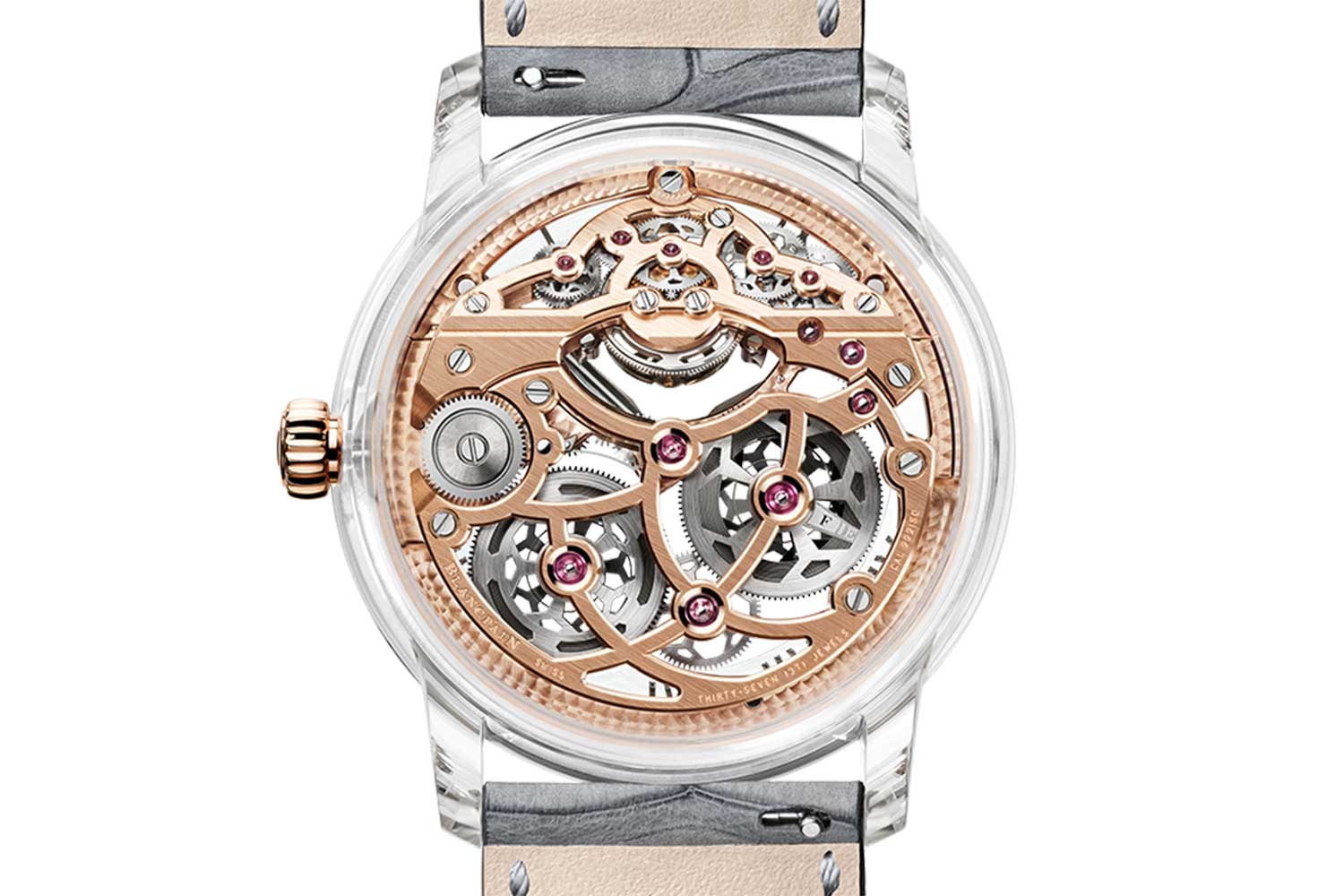
The extensively openworked 18k gold movement is replete with sharp inward angles on both sides, 253 of them beveled and polished by hand
Its transparency exposes the movement from the sides as well as the front and back, so the inclined carrousel and its transmission paths can be examined from several angles. A sapphire dial preserves the view, with gold appliques and luminous hands that provide a legible display above the mechanics.
Two versions have been released, with the openworked gold movement either rhodium-plated or left in red gold. Both have a sapphire case and a stated price of US$502,600. It is not a limited edition, but production is expected to be extremely limited.
-
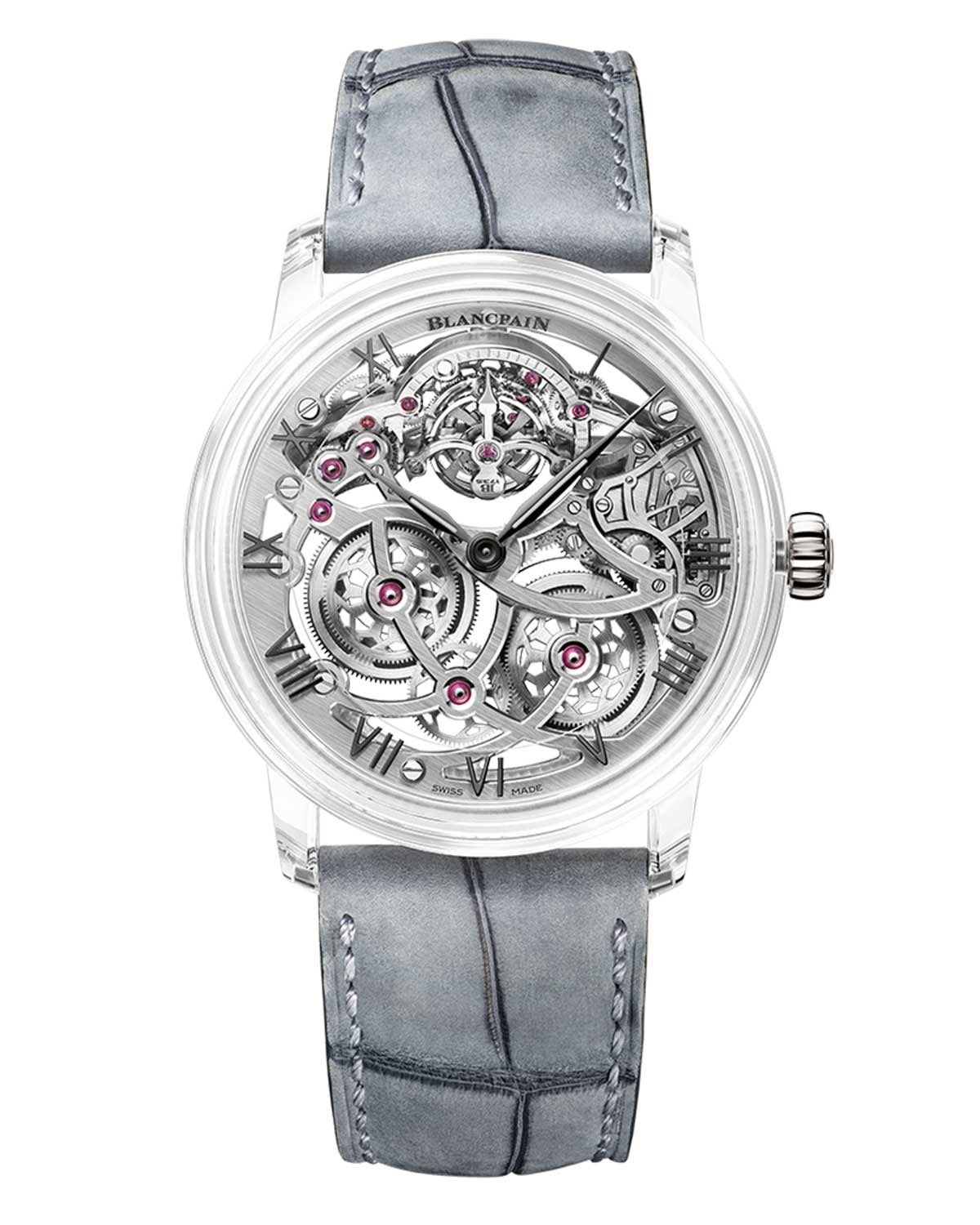
- Blancpain Carrousel Incliné in rhodium-plated gold
-
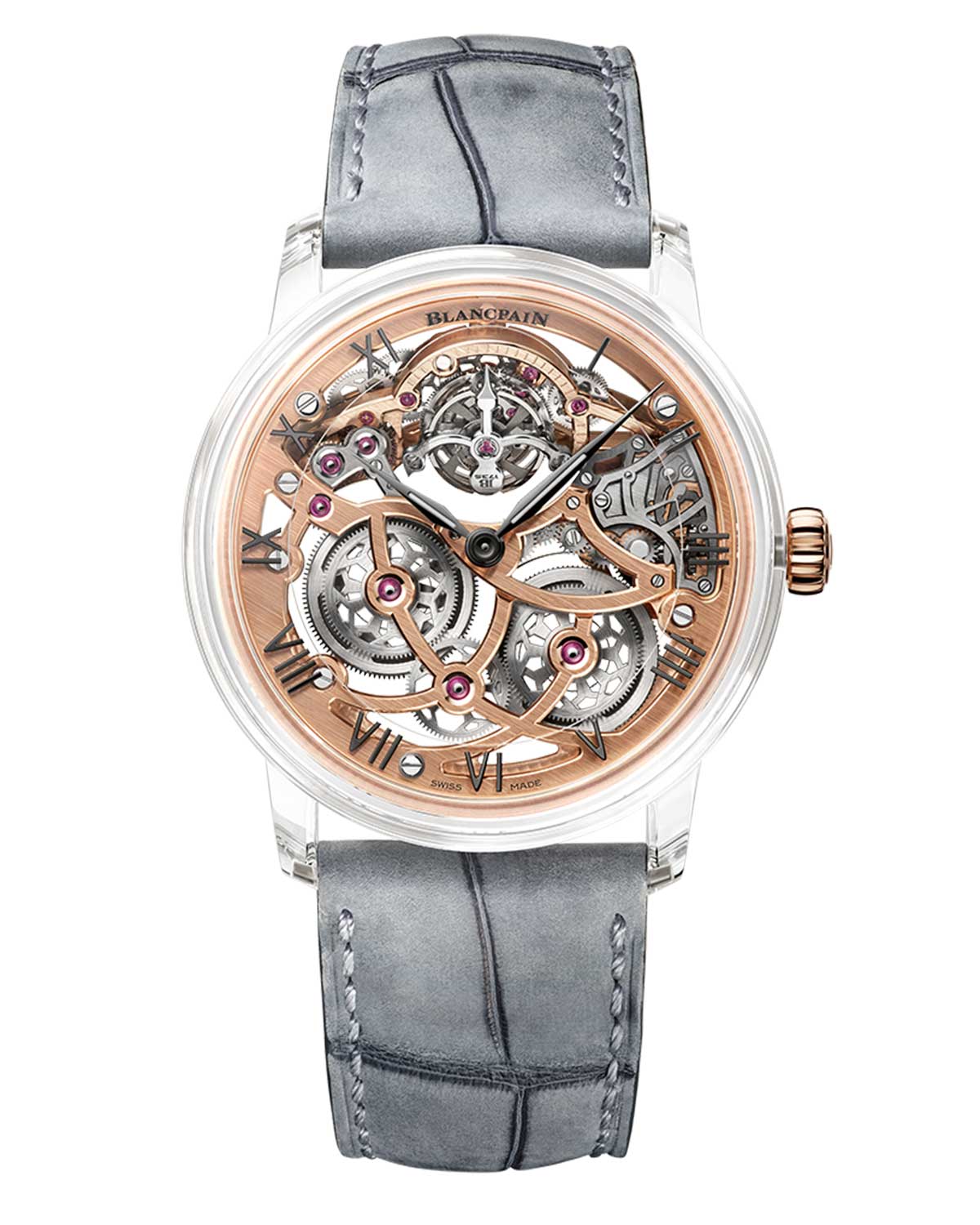
- Blancpain Carrousel Incliné in red gold
The First Inclined Carrousel: Calibre 222ISQ
The Calibre 222ISQ measures 35.2mm in diameter and 5.3mm thick. At the highest point of the inclined cage, the movement is 6.98 mm. It is equipped with two mainspring barrels connected in series that hold a total power reserve of 100 hours. As opposed to single large barrel with a long mainspring, this arrangement delivers a more even torque curve as the mainsprings unwind and helps maintain consistent performance throughout the power reserve. Openings in the barrel drums reveal the mainsprings, so their state of wind can be assessed directly.
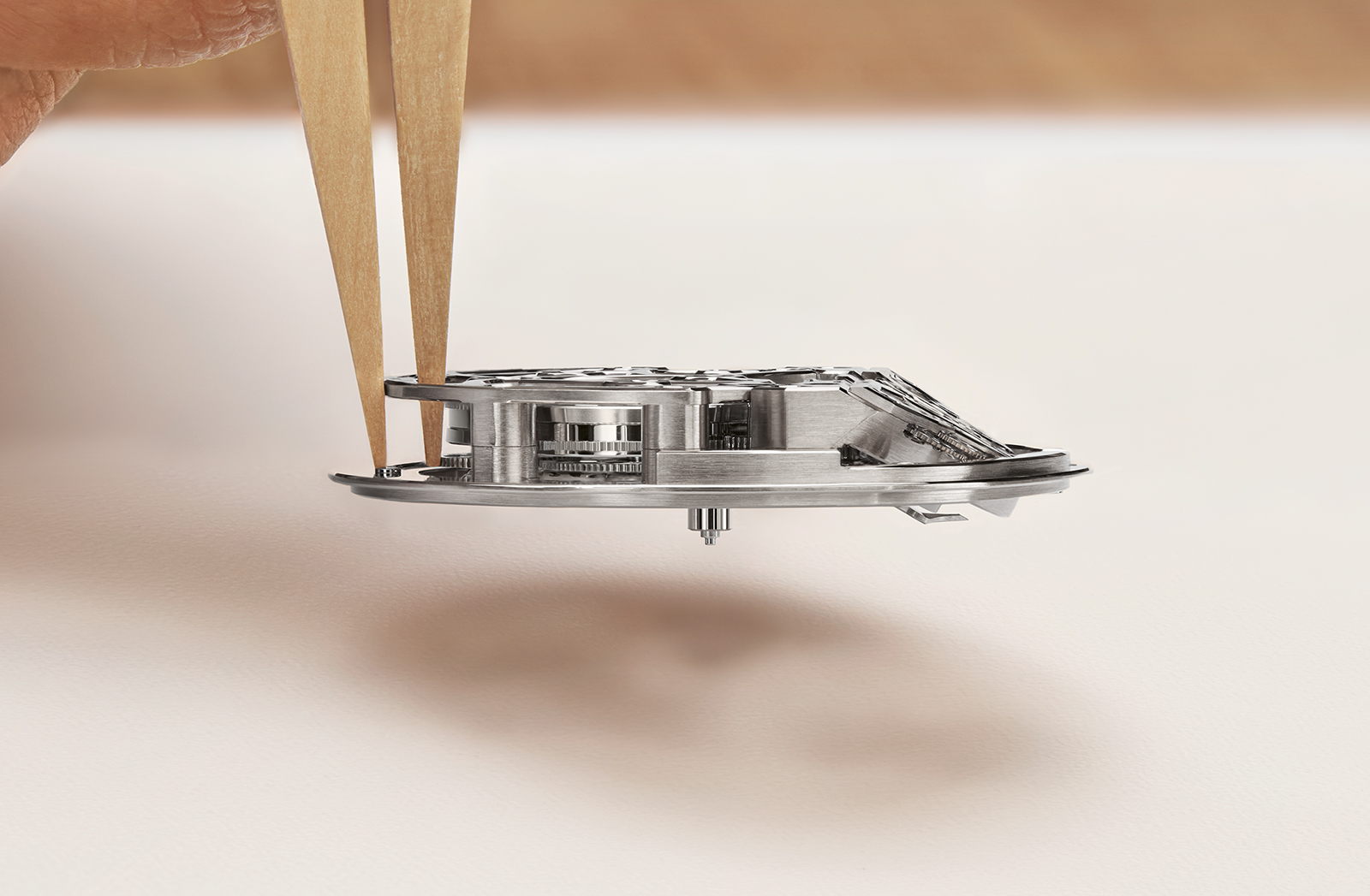
The carrousel at the right sits at 30 degrees to the mainplate. The Calibre 222ISQ measures 5.3 mm thick, rising to 6.98mm at the highest point of the cage
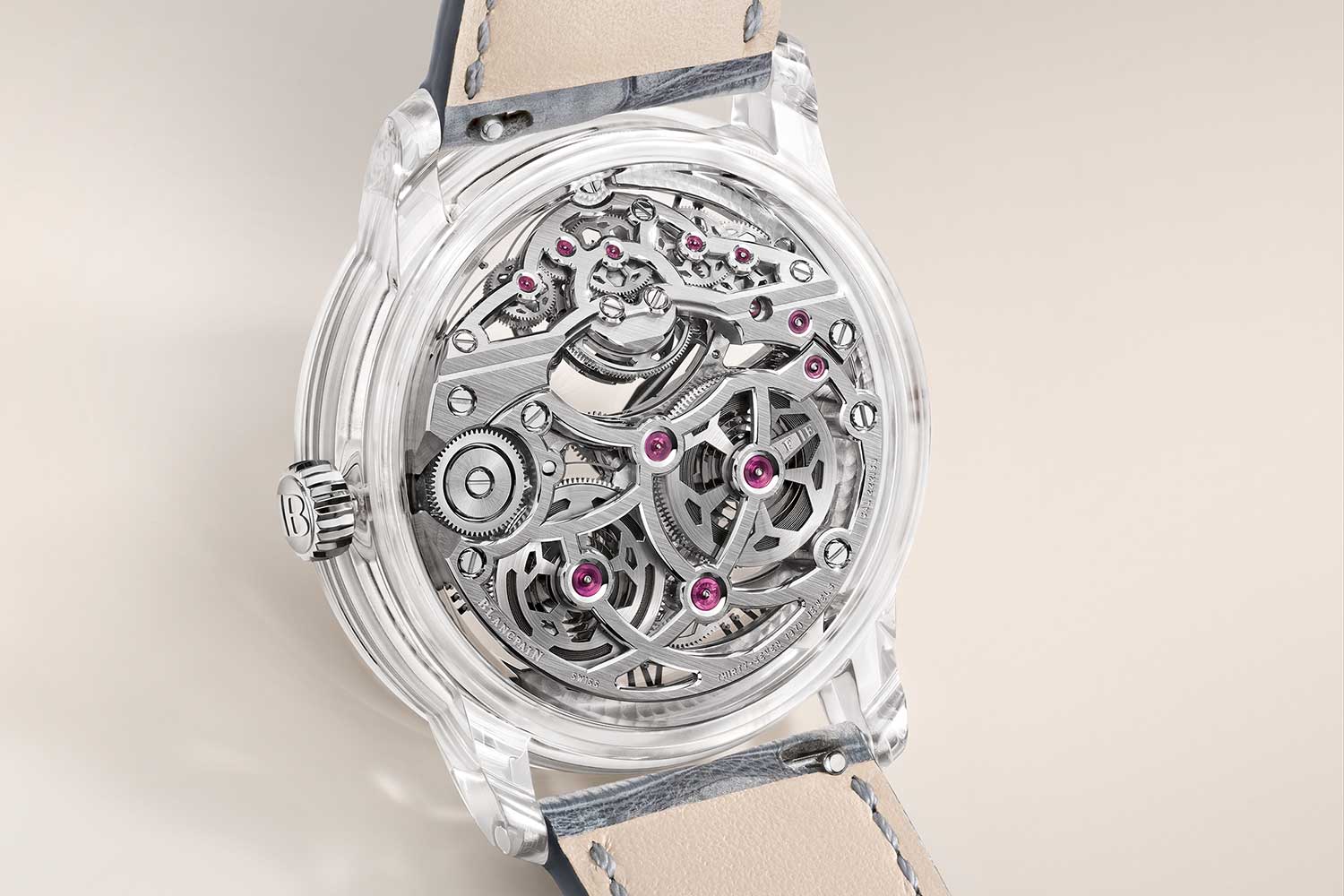
The twin mainspring barrels occupy the lower two-thirds of the movement. Above them, a sloping bridge supports the carrousel and its inclined gear train
Blancpain’s carrousels have traditionally operated at 21,600vph, except for the minute repeater models, which ran at 28,800vph. The new Calibre 222ISQ adopts the higher frequency of 28,800vph, or 4Hz, with a silicon hairspring and an 8mm balance equipped with inset adjustment screws. The free-sprung balance is larger in diameter than its predecessor but has the same inertia. The cage, however, is both smaller and lighter. Its mass and rotational inertia have been reduced by 8.5 percent and 30 percent respectively. The greater reduction in inertia indicates that the redesign brings mass closer to the rotation axis, where it offers less resistance to angular acceleration. This matters as the cage advances in small steps under the control of the escapement.
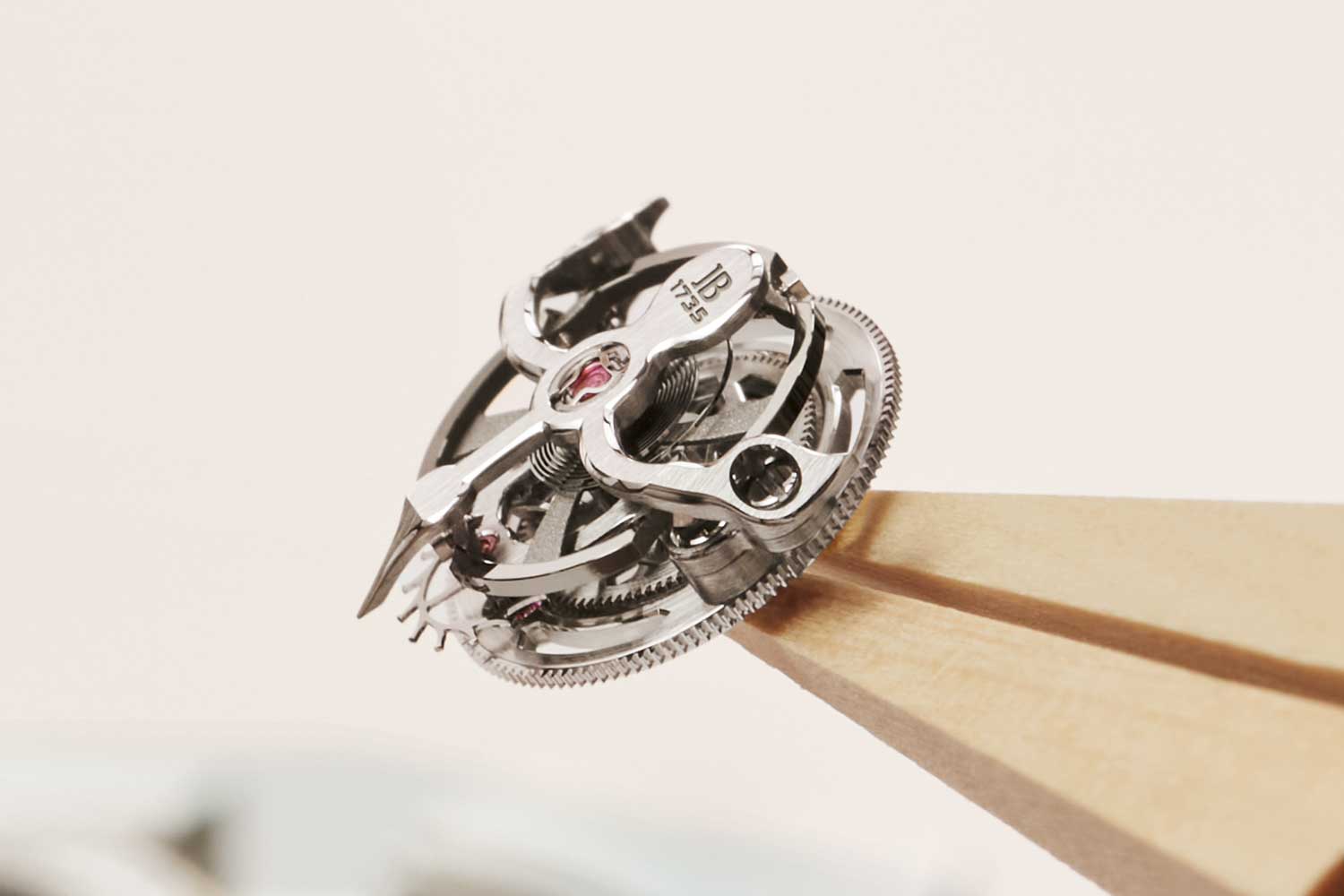
The compact carrousel pairs an 8mm balance with a 9mm cage wheel along with curved upper arms, while two concentric ball bearings beneath the cage keep the inclined assembly slim
Its toothed lower wheel now measures 9mm in diameter, only slightly larger than the balance itself. The proportions give the oscillator greater prominence, while the smaller cage helps limit the height occupied by the assembly at its 30-degree inclination. The cage still completes one revolution per minute, with a seconds pointer that bends slightly downwards to clear the crystal.
The means by which its rotation is achieved distinguishes the carrousel from a tourbillon. In a tourbillon, the going train drives the cage, and its rotation causes the escape pinion to travel around a fixed wheel. The cage therefore forms part of the power path to the escapement. A carrousel, on the other hand, dispenses with the fixed wheel and divides the transmission into two linked branches – one supplies the escapement, while the other governs the rotation of the cage. In other words, the cage is outside the direct drive path to the escapement. In the traditional Bonniksen construction, the going train drives the fourth wheel in the usual manner, while the third pinion turns cage. The escape wheel remains aboard the cage, so its pinion travels around a fourth wheel that itself rotates in the same direction. Its operation hence depends on the speed of the fourth wheel relative to the cage.

The differences between a tourbillon and carrousel
Early makers generally prioritized the frequency and straightforward gearing, then accepted the resulting slow rotation of the cage. Blancpain addressed this in 2008 by abandoning the conventional one-minute rotation of the fourth wheel. The fourth wheel that drives the escape pinion completes two revolutions per minute, while the cage completes one in the same direction. Relative to the cage, the fourth wheel hence makes one revolution per minute, allowing a conventional balance and escapement to operate at their usual frequency. The cage itself takes over the indication of seconds.
In the Carrousel Incliné, power must first pass from the train mounted in the mainplate to the gearwork beside the carrousel. The train wheels thus cannot all have parallel axes because the carrousel assembly sits at 30 degrees to the mainplate. Hence, two successive gear meshes divide this change of plane into steps of 22 and 8 degrees. The teeth are oriented and cut to suit the angle between the mating arbors. Both engagements precede the separation into two transmission paths, which operate in the same inclined plane.
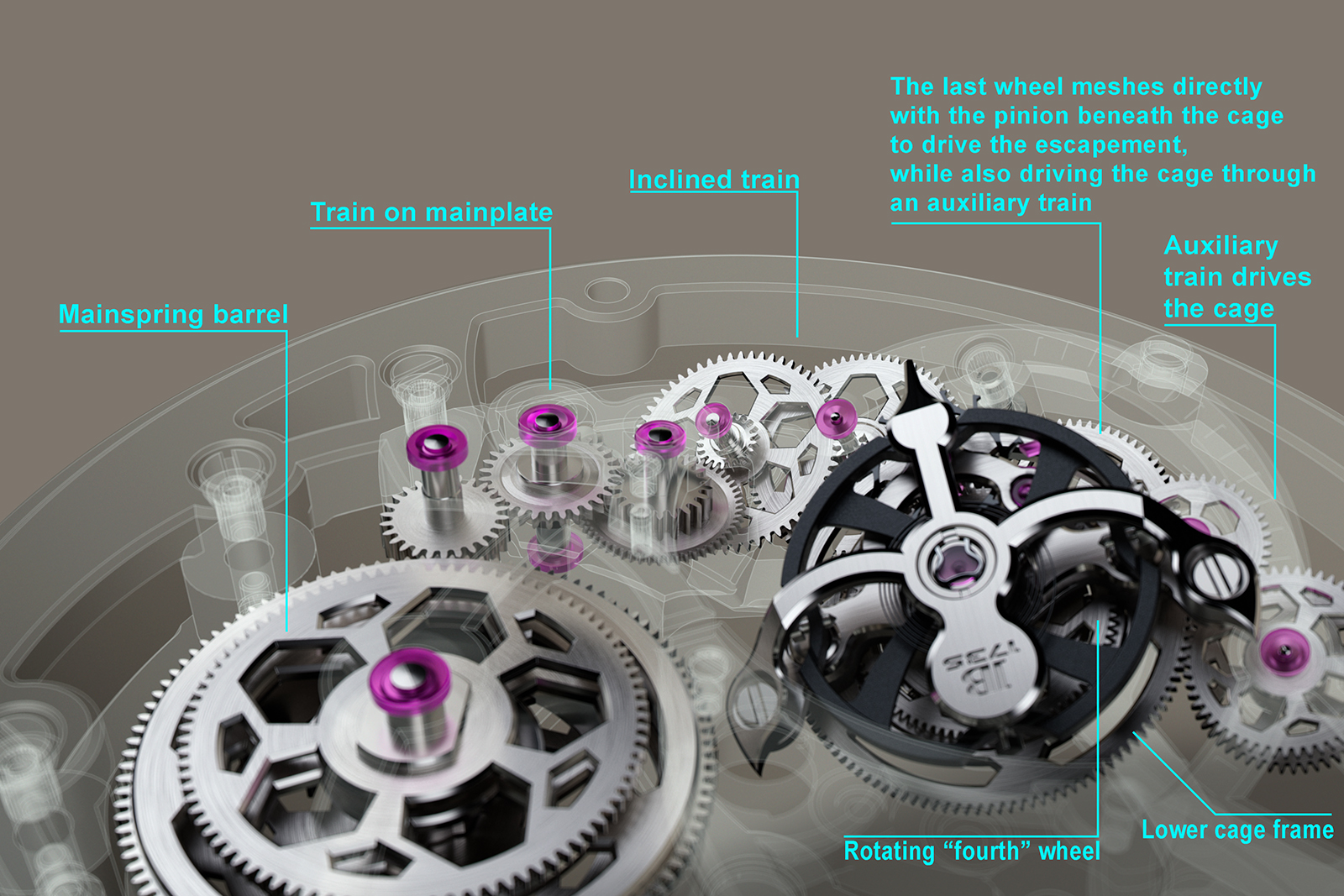
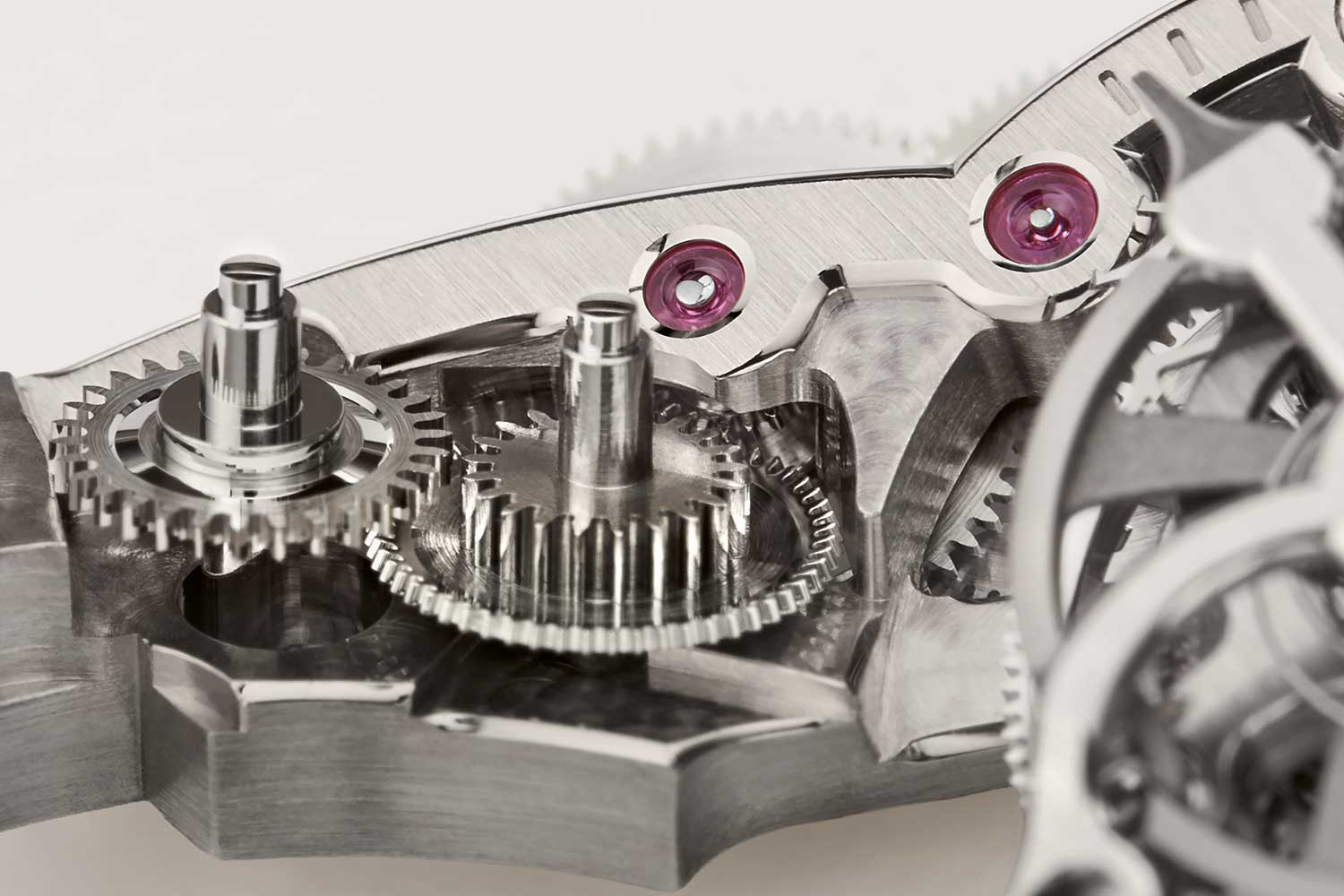
The teeth of the lower wheel angle upward to mesh with the pinion on the inclined arbor, transmitting power across the first 22-degree change of plane
A common drive wheel then feeds both paths. It meshes directly with the fourth pinion beneath the cage, and the “fourth” wheel drives the escape pinion inside the cage. The other path reaches the cage through two compound wheel sets. The drive wheel engages the pinion of the first compound set; its wheel drives the lower wheel of the second set, and the upper wheel meshes with the peripheral teeth of the cage. These compound sets establish the required ratio between the central arbor and the cage.
Conventionally, the central arbor that drives the escapement runs in bearings at both ends, with a separate bearing to support the cage. Supporting the drive arbor at both ends adds to the height of the carrousel assembly, a particular concern when the cage is inclined. Blancpain replaced those end bearings with a single ball bearing nested concentrically within the cage bearing, both at the same height. A stationary intermediate ring secured to the movement separates the two. The outer bearing supports the cage while the inner bearing supports the drive arbor. As such, both parts can turn at their respective speeds within a shallower assembly.
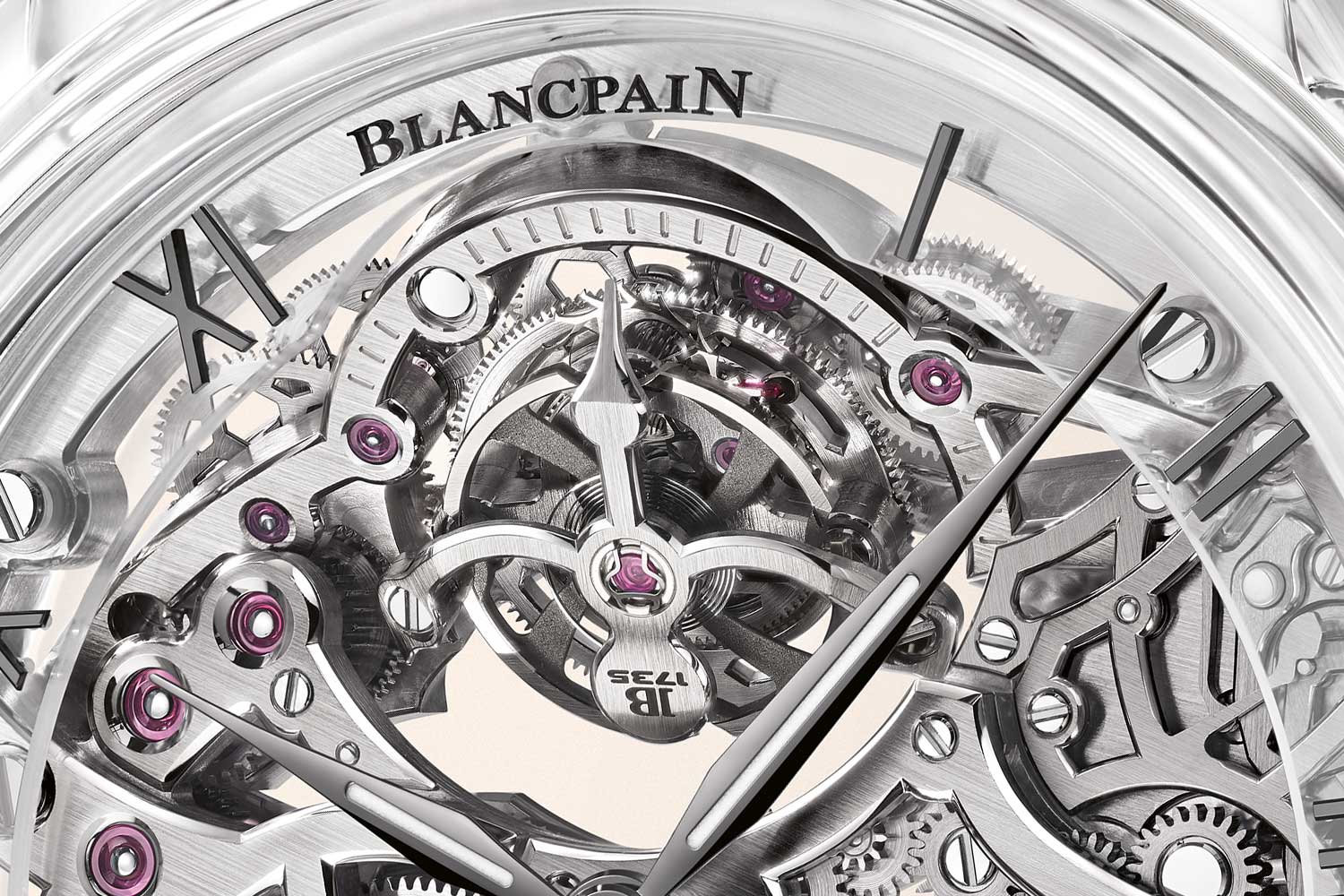
The openworking allows the characteristic dual transmission paths of the carrousel to be seen and followed, which is, in itself, a unique treat.
No Holds Barred: The Finishing
The movement rewards attention well beyond the inclined cage. The gold mainplate and bridges have been dramatically openworked and elaborately decorated with anglage on both the front and the back, with broad upper bevels cut at 30 degrees and lower bevels at 45 degrees.
Recent discussions among enthusiasts have prompted a closer examination of what constitutes fine finishing. CNC and other automated tools can produce surfaces that need little or no subsequent handwork, and even sharp internal corners are no longer sufficient proof of a craftsman’s intervention. The natural response is to ask to see how the work is done, and Blancpain has provided a precise account along with images of the handwork that brings the movement to its finished state.
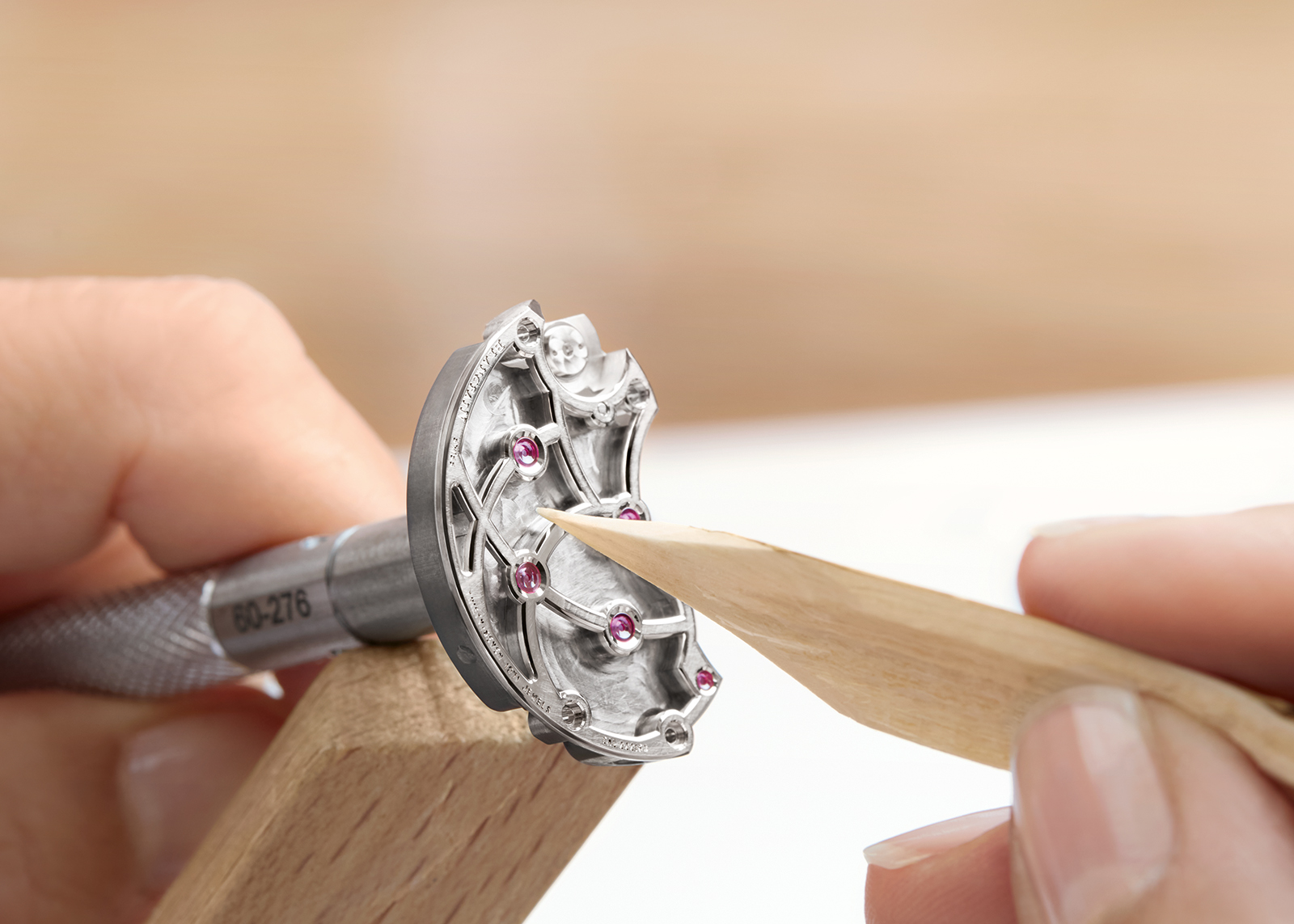
Polishing the inward angles of the dial-side barrel bridge using gentian wood
-
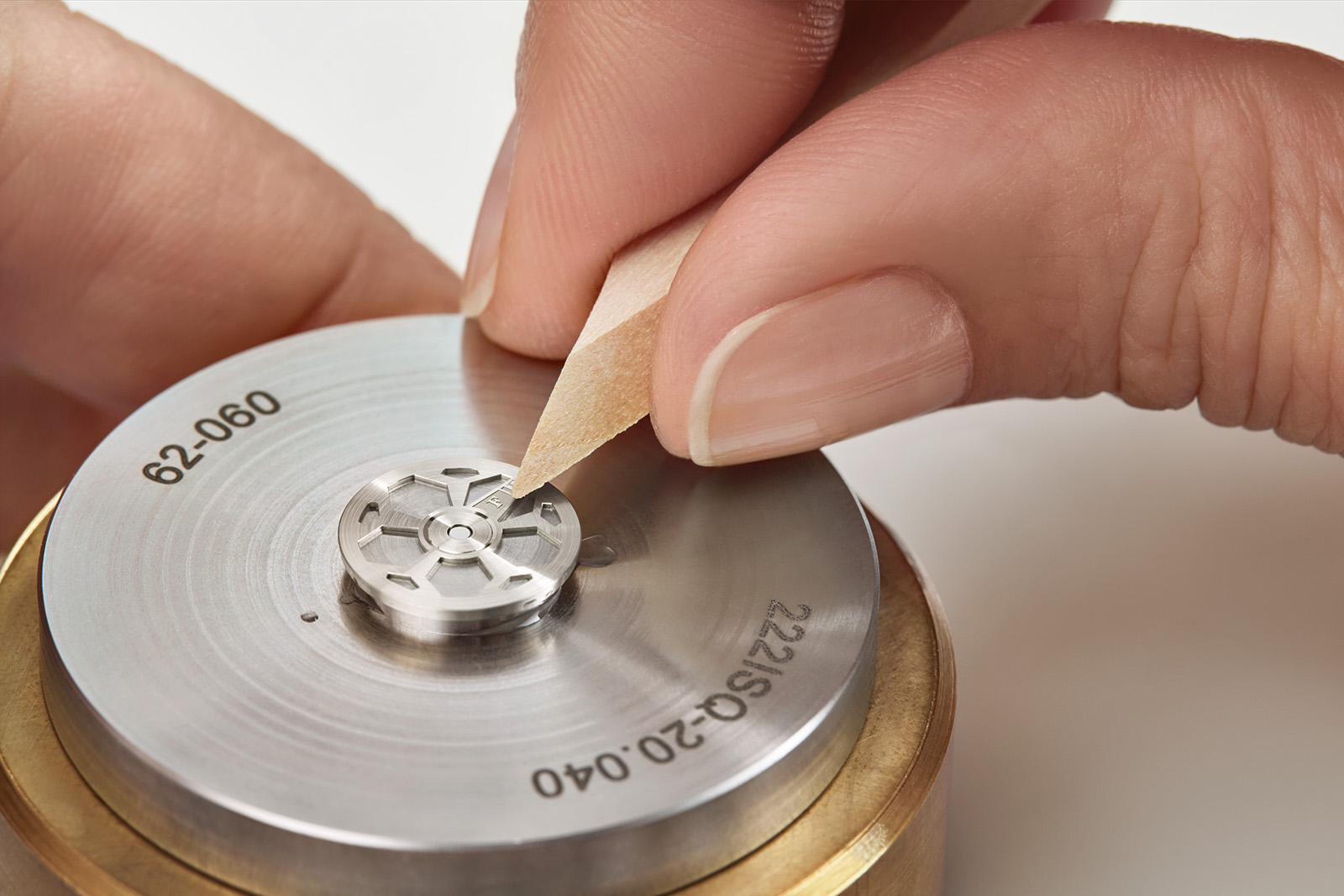
- The openings in the mainspring barrel reveal the state of wind, and their edges are polished by hand
-
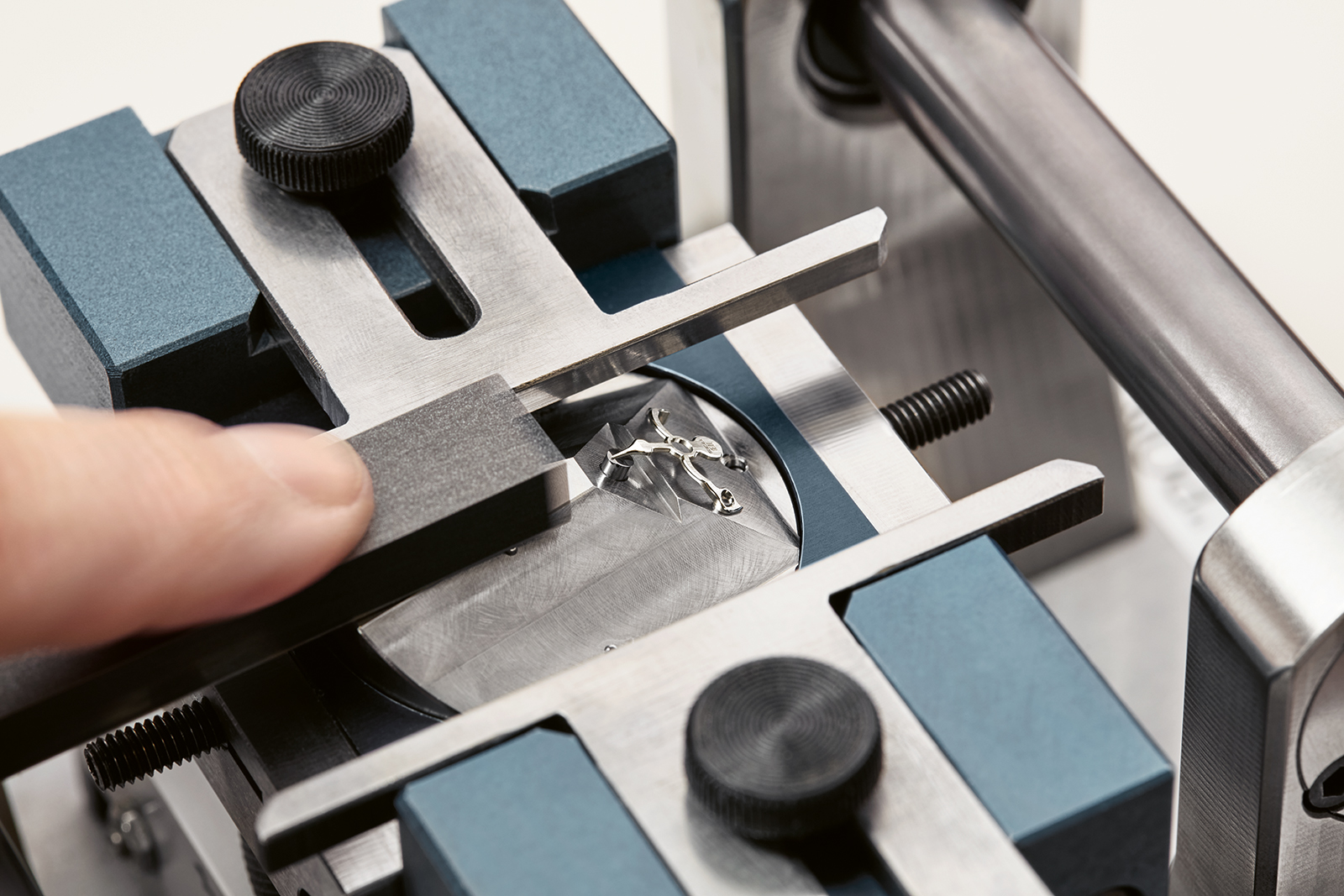
- A artisan applies a brushed finish to the tip of the carrousel’s beak-shaped seconds indicator
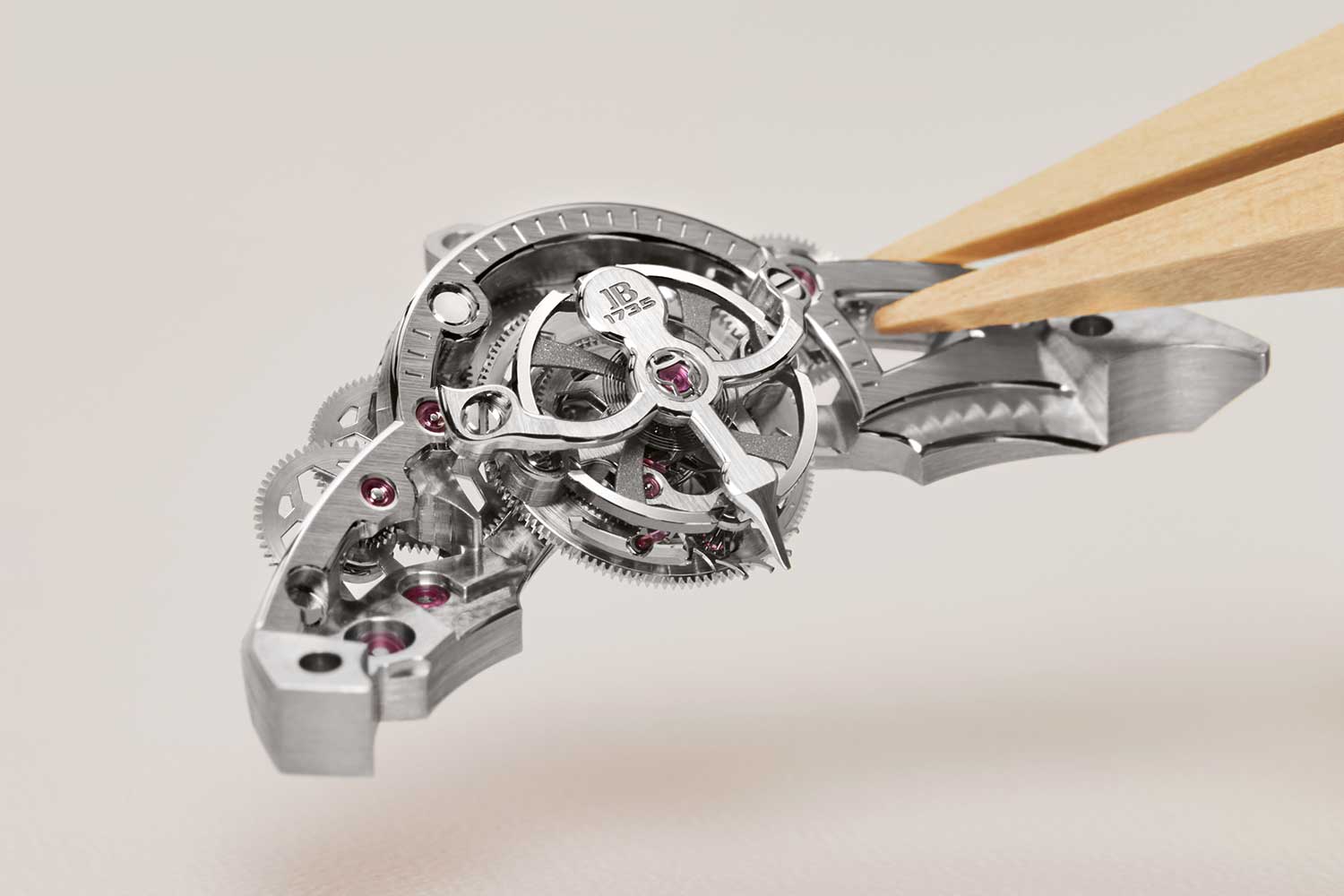
Anglage is applied the traditional way without recourse to rotary tools. The artisan begins with a burin, then proceed through progressively finer abrasive papers on wooden files. The final polishing is then carried out with gentian wood charged with diamond paste. Blancpain specifies 253 sharp inward angles, excluding the stamped corners of the lower cage wheel, and reports that more than 60 custom tools were made for the movement’s decoration. The mainplate or barrel bridge alone requires 55 to 60 hours, while the lower inclined bridge with a significant number of internal angles occupies approximately a week and a half. In total, the Calibre 222ISQ receives 210 hours of hand finishing.
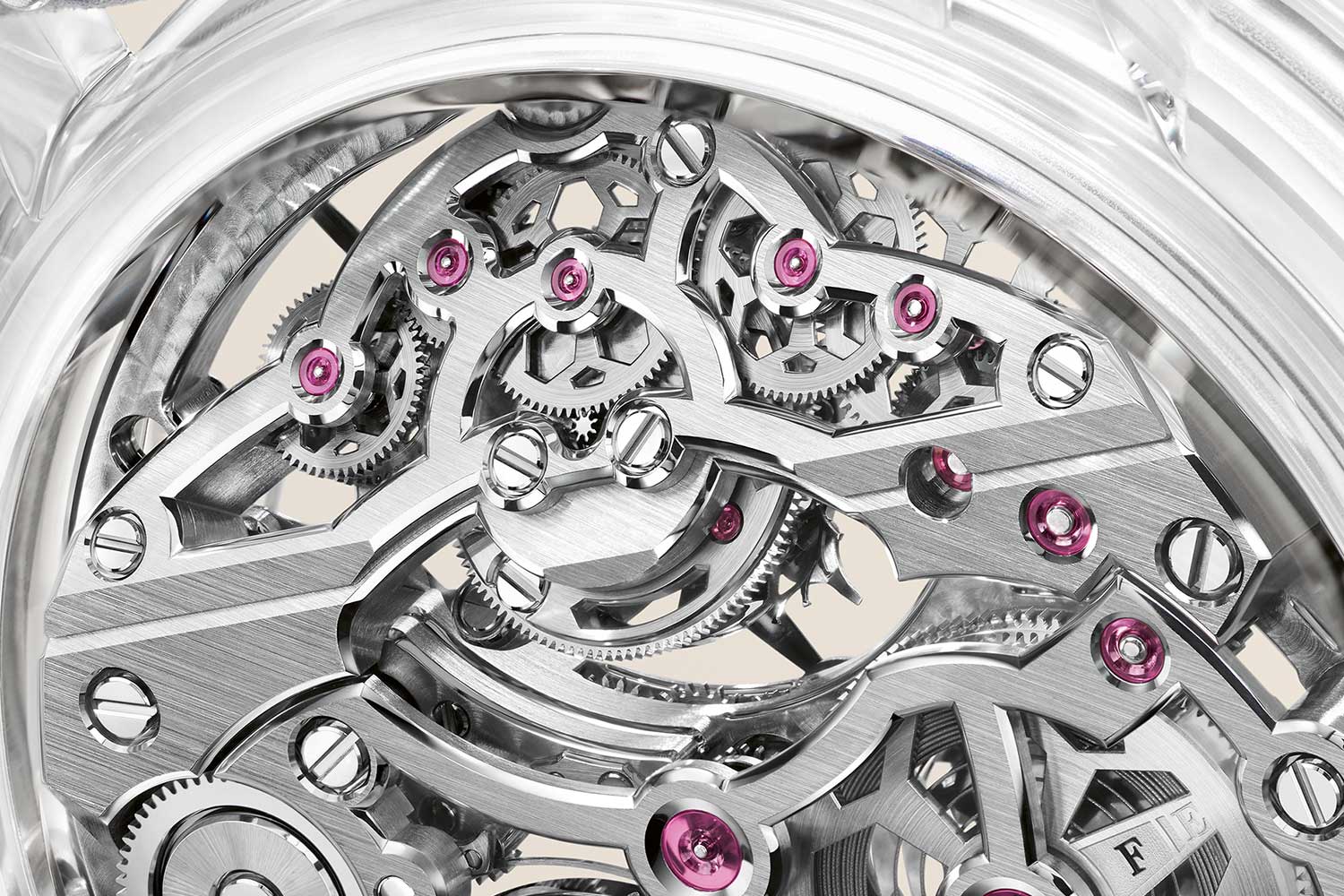
The inclined carrousel bridge alone takes a week and a half to finish by hand, with sharp inward angles throughout
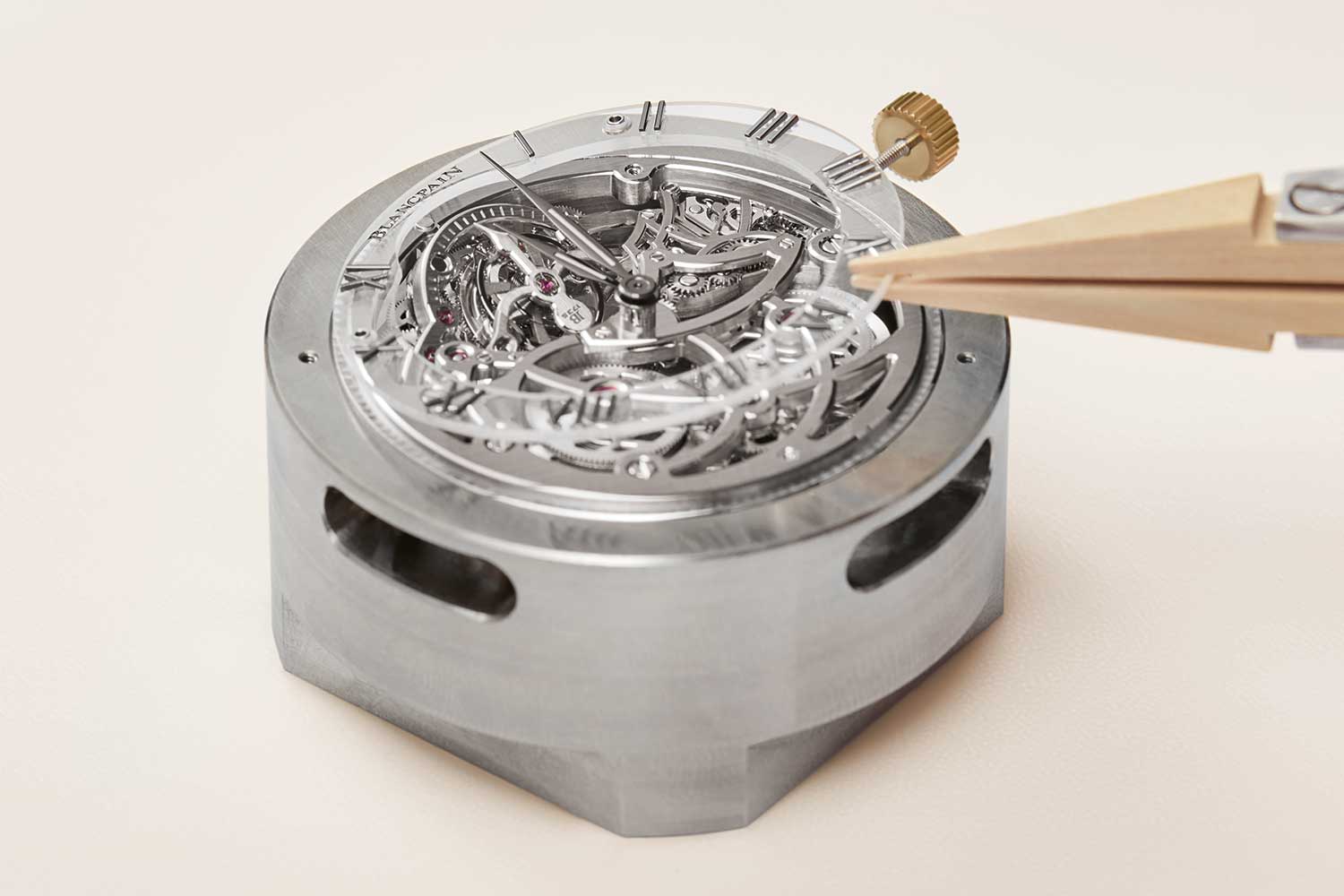
It is difficult to say which deserves greater admiration – the engineering behind the movement or the labor devoted to its decoration. The pleasure of fine watchmaking lies in the union of the two, and the Carrousel Incliné offers an unusually complete expression of both, with the added distinction of a mechanism unique to Blancpain and significant both to the brand and to the history of watchmaking.
Tech Specs: Blancpain Carrousel Incliné
Movement: Manual-winding calibre 222ISQ in rhodium-plated or red 18k gold, with a one-minute flying carrousel inclined at 30 degrees and a silicon hairspring. Frequency of 4 Hz or 28,800 vph. 100-hour power reserve. Certified mean daily rate of 0 to +2 seconds per day.
Functions: Hours, minutes and seconds indicated by the carrousel
Case: 40.30 mm by 11.30 mm, sapphire, water resistant to 30 m (3 bar)
Dial: Sapphire with gold appliqués
Strap: Interchangeable glazed blue-grey leather with a gold folding clasp and safety catch
Price: US$502,600