Pre-treatment for prostate cancer now done at Tan Tock Seng Hospital outpatient clinic, local anaesthesia
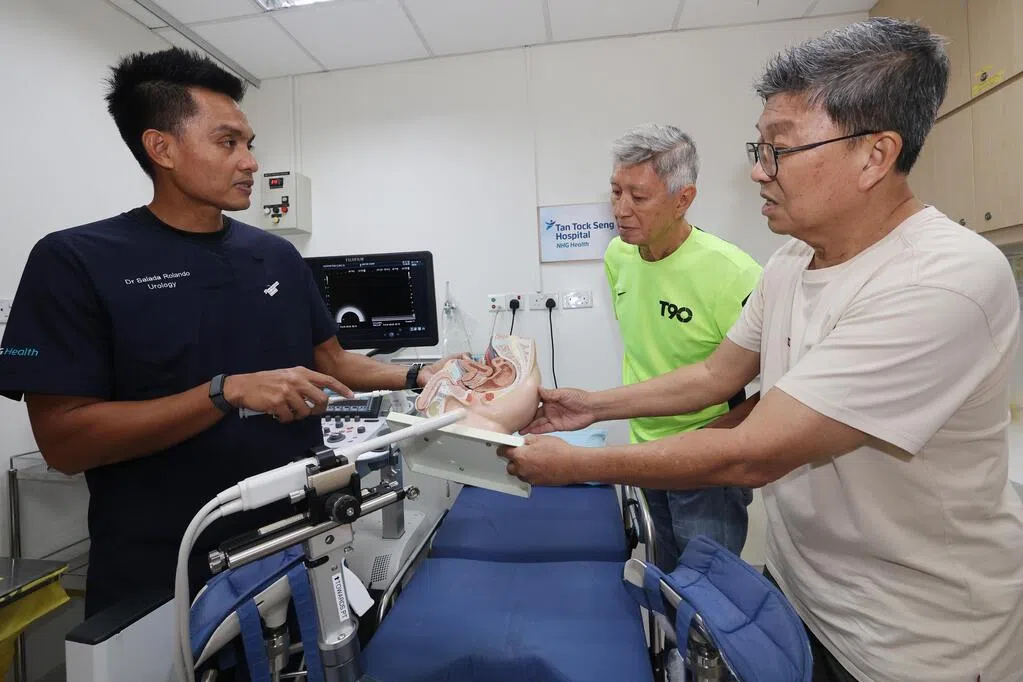
Guo Laiwan, 81, had always been in good health. A few months ago, he sought treatment for a urinary tract infection and was diagnosed with prostate cancer after a blood test. He opted for radiotherapy and had a rectal spacer implanted beforehand at a specialist outpatient clinic at Tan Tock Seng Hospital. The hospital is the first in Singapore to move this preparatory procedure to an outpatient setting, and Guo was among the first patients to undergo it there.
The rectal spacer procedure involves injecting a gel-like substance called hydrogel between the prostate and rectum to create a physical gap. This reduces the radiation dose reaching the rectum during radiotherapy, lowering the risk of side effects such as blood in the stool.
The procedure was previously performed in an operating theatre under general anaesthesia. At the specialist outpatient clinic, patients need only local anaesthesia.
Home after about an hour’s observation, back to pull-ups two days later
Guo underwent the procedure at Tan Tock Seng Hospital’s specialist outpatient clinic this month. In an interview, he said he felt a slight sting when the local anaesthetic was injected and only a little pressure when the gel was administered, with no significant pain.
He said: “After general anaesthesia, you feel groggy, need to trouble your family to take you home and may even have to stay in hospital. So if I go for LA, I mean the procedure is so much simpler. Afterwards, I just rest briefly at the clinic and, once I can pass urine normally, I can take transport home on my own.”
Guo usually exercises five or six days a week. He rested for just two days after the implant procedure before resuming his pull-ups. He is scheduled to begin radiotherapy in January next year.
Sparing older patients the risks of general anaesthesia and freeing up operating theatres
Previously, rectal spacers had to be implanted in an operating theatre under general anaesthesia. This required an anaesthesia team, and patients often had to remain in hospital for observation for much of the day afterwards.
After more than a year of clinical evaluation, Tan Tock Seng Hospital made the outpatient procedure under local anaesthesia its default approach in May this year.
Assistant Professor Daniel Yong Zhan Peng, head and senior consultant at Tan Tock Seng Hospital’s Department of Urology, said the new approach has benefited more than 80 patients aged over 60 so far. The hospital sees about 80 to 100 prostate cancer patients each year.
Dr Salada Rolando Li Barinque, chief resident at Tan Tock Seng Hospital’s Department of Urology and lead for its rectal spacer programme under local anaesthesia, said the hydrogel is about 90% water. Its other components include hyaluronic acid, and it is gradually broken down and absorbed by the body after implantation.
In an interview, Dr Salada said performing the procedure in an outpatient clinic under local anaesthesia makes treatment safer for older and frail patients as well as quicker. It also reduces the observation period afterwards to about an hour and saves patients about $400.
More importantly, the arrangement frees up valuable operating theatre resources for more complex surgery.
“Other hospitals usually perform this procedure under general anaesthesia. When patients cannot undergo general anaesthesia, they refer them to us.”
Retiree returns to hiking with few side effects after radiotherapy
Yu Ranfeng, 69, was found to have an elevated prostate-specific antigen (PSA) level during a routine health check early this year and was subsequently diagnosed with prostate cancer. Concerned that surgery to remove the prostate could cause long-term urinary incontinence or leave him needing a urine bag, he also opted for radiotherapy.
Yu had a rectal spacer implanted at Tan Tock Seng Hospital’s outpatient clinic in August and completed 20 radiotherapy sessions over four weeks in September. His out-of-pocket expenses after government subsidies came to about $200.
According to the Singapore Cancer Society, prostate cancer is one of the most common cancers among men in Singapore, and the risk rises significantly with age.
Tan Tock Seng Hospital’s medical team reminded the public that prostate cancer usually has no symptoms in its early stages. Men aged over 50 or with a family history of the disease are therefore advised to consult a doctor about whether they need screening, such as a PSA test, to enable early detection and treatment.