Existing drug helps mice clear blood through meningeal lymphatic system after stroke
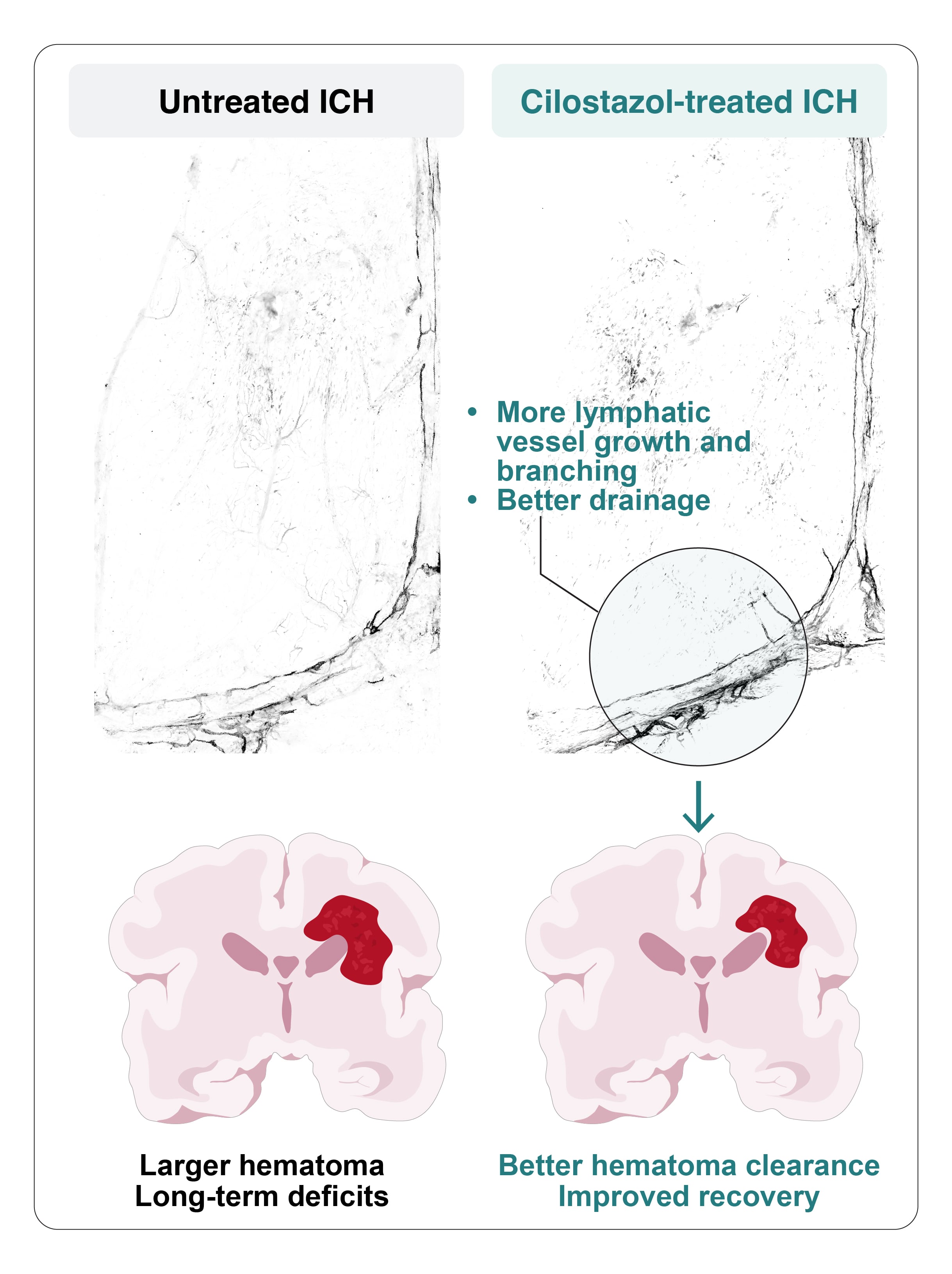
A drug already used to improve blood circulation and prevent certain types of stroke could have an unexpected new role in promoting recovery after bleeding in the brain. In a study published in Stroke, a team led by researchers at National Taiwan University found that cilostazol helped mice recover from intracerebral hemorrhage (ICH) by boosting the brain’s natural drainage system.
ICH occurs when a blood vessel ruptures inside the brain. The accumulating blood forms a hematoma, which can compress surrounding tissue and release harmful substances as red blood cells break down. Although surgery can help selected patients, treatment options for removing accumulated blood and promoting recovery remain limited, particularly for people with bleeding deep within the brain.
The researchers focused on lymphatic vessels in the protective membranes surrounding the brain. These vessels help drain fluid and waste to lymph nodes in the neck. Building on earlier discoveries that this drainage network contributes to blood clearance after a hemorrhage, the team investigated whether cilostazol could strengthen this natural clean-up system.
In a mouse model of brain hemorrhage, the researcher began oral cilostazol treatment three hours after the hemorrhage, using doses equivalent to those commonly used in humans. Treatment promoted the growth and branching of lymphatic vessels and improved drainage to lymph nodes in the neck. Treated mice had smaller hematomas, less damage to nerve cells and their connections, and better motor and neurological function. One week of treatment also improved several measures of memory nearly one month after the hemorrhage.
One major concern was that cilostazol reduces the tendency of platelets to clump together, potentially worsening bleeding. However, mice that received the drug before a hemorrhage or began treatment three days afterward did not develop larger hematomas under the conditions tested. The benefits of delayed treatment suggest that the approach may offer a clinically useful window for intervention.
The findings provide a scientific foundation for an ongoing phase II randomized clinical trial (NCT06504576) investigating cilostazol for hematoma clearance in patients with intracerebral hemorrhage. As the experiments were conducted in male mice, further research is needed to establish the treatment’s safety and effectiveness in patients.
“Rather than focusing only on stopping the bleeding, we want to harness the brain’s own drainage system to help remove accumulated blood and support recovery. Repurposing an existing oral medication could bring this approach closer to patients, if its benefits and safety are confirmed in clinical trials,” says corresponding author Che-Feng Chang, Ph.D., associate professor of physiology at National Taiwan University.
Prof. Che-Feng Chang’s email address: [email protected]
Keywords: Diseases; Health; Medicine; Science; Neuroimmunology
