Judicial decision may prompt legislative action, but judiciary has not assumed political function: CJ
SINGAPORE – A judicial decision may prompt a review of practice by the Cabinet, public consultation or changes by Parliament but this does not mean the judiciary has assumed a political function.
Chief Justice Sundaresh Menon on Nov 25 said such reviews simply reflect the way in which the other branches of government work through legal implications of a judgment as they exercise their own constitutional responsibilities.
In Singapore, the branches of government are the executive, which comprises the Cabinet, the legislature, which comprises Parliament, and the judiciary.
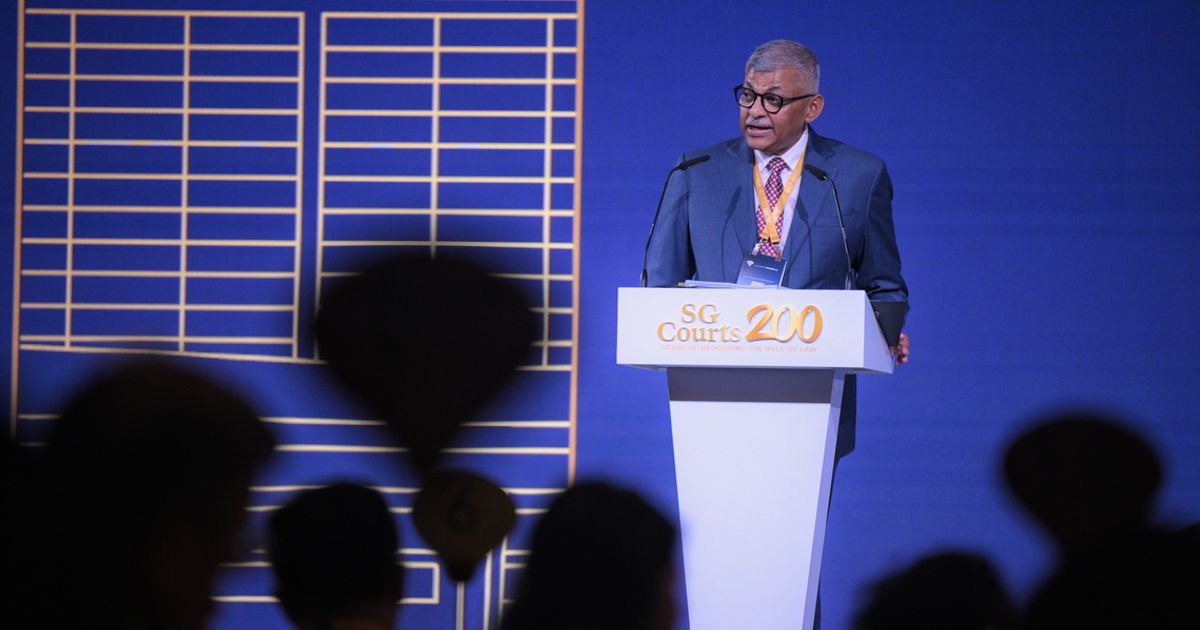
Menon was delivering the keynote address at the Global Rule of Law Conference held at Shangri-La Hotel.
His comments came after the introduction of the Sentencing (Scams) Bill in Parliament on Nov 3, which followed a recent High Court ruling that favoured rehabilitative options for young scam offenders.
The High Court had in September allowed the appeals of four young scam offenders who were sentenced to reformative training, and instead ordered them to be placed on probation ranging from a year to 18 months. These four committed their offences while under the age of 21.
The proposed law means that young scam mules could soon face jail or reformative training as the default punishment rather than probation, to reinforce the Government’s deterrent stance against such offences.
In his speech, the outgoing Chief Justice, who is due to retire in February 2027, cited the example of Singaporean businessman Tan Seet Eng, who was detained without trial in 2013 by order of the minister under the Criminal Law (Temporary Provisions) Act, on the basis that the detention was in the interest of public safety, peace and good order.
Tan was alleged to be the leader and financier of a global football match-fixing syndicate.
Menon said the Court of Appeal set aside the minister’s order, holding that the Act permitted detention only where the detainee’s acts were harmful in Singapore, and that the grounds provided did not establish if or how Tan’s activities bore on public safety, peace and good order here.
The consequences of the decision extended beyond Tan, said the Chief Justice.
Although Tan was subsequently detained under a fresh order specifying the relevant harm in Singapore, the Ministry of Home Affairs reviewed other detentions and released three other detainees whom no court had ordered it to release.
Noting how this case was constitutional dialogue in practice, Menon said: “The court interpreted the statute and enforced its limits. The executive then considered the wider implications of that legal ruling and applied them to the administration of the regime in other cases.
“Neither institution assumed the function of the other, but each responded within its proper constitutional lane.”
Menon also cited the constitutional challenges to Section 377A of the Penal Code, which previously criminalised acts of “gross indecency” between men.
The Court of Appeal had dismissed the challenges on procedural grounds due to the Government’s non-enforcement policy, avoiding a direct ruling on whether the law should remain in force.
However, the court noted in its observations how developments in constitutional equality jurisprudence could affect future challenges.
The Attorney-General subsequently advised the Government that based on the court’s observations, there was a significant risk that Section 377A would be struck down in a future challenge.
The Government then undertook extensive consultations with affected groups before deciding to repeal the provision.
“The court addressed the legal questions that properly fell within its province, while leaving the broader social and political question to institutions better placed to consult, mediate and arrive at a political accommodation,” said the Chief Justice.
“The work of one branch thus informed the response of another, even as each remained within its proper constitutional sphere.”
Constitutional roles
The Chief Justice also noted how Singapore’s Constitution assigns legislative, executive and judicial power to different institutions, with each having its own constitutional role, and how each must respect the limits of that role.
While the courts are responsible for interpreting and applying the law, and for ensuring that public power is exercised within legal limits, the courts must also recognise that some issues, particularly those involving complex questions of policy and the balancing of competing social interests, are properly entrusted to the political branches, said Menon.
“Equally, authoritative judicial determinations must be respected by those branches. The rule of law depends on both sides of that equation,” he added.
The Chief Justice also highlighted that while political branches are afforded the latitude needed to govern effectively and to make difficult choices on behalf of the community, they remain subject to legal limits enforced by an independent judiciary.
“And within that constitutional order, dialogue between the branches of state allows each to respond to the others while remaining faithful to its own constitutional role,” he added.
Communitarian emphasis
In his speech, Menon said that Singapore’s understanding of the rule of law is based on a communitarian emphasis, which sees the rights of the individual protected, but also with conditions that enable everyone to exercise these freedoms meaningfully.
Noting that law must often mediate between the rights and interests of different individuals, and between the individual and the wider community, Menon pointed out how the unrestrained freedom of one person will almost invariably affect the freedom of another.
“A communitarian conception is therefore concerned not only with protecting individual freedom, but also with sustaining the conditions that enable us all, collectively, to exercise that freedom meaningfully,” he said.
This differs in emphasis from a rights-centred approach that stresses individual rights and constraints on public power, added Menon.
Noting that the contrast should not be overstated, he said: “Both approaches recognise the importance of rights and legal limits on public power, but the communitarian perspective places greater weight on the wider context in which individual rights are exercised.”