StarHub-M1 merger: Cheap plans are on borrowed time, and history risks repeating
SINGAPORE – Fourth telco Simba Telecom has lost out on buying M1 following regulatory probes into its alleged unauthorised use of mobile air waves.
Yet rival StarHub’s move on Nov 24 to snap up M1 sent shares of Simba’s Australian parent Tuas surging 32.4% to close at A$1.80 that day.
On the Singapore Exchange, local rivals also climbed. StarHub went up 3% to $1.04, while Singtel rose 0.2% to $4.13 when the market closed on Nov 24.
What do these share price movements tell Singapore mobile subscribers about what comes next? When financial markets celebrate a telco merger, sending both the buyer (StarHub) and its remaining rivals higher on the same day, investors are usually betting on the return of higher profit margins or the impending end of a price war that cuts margins razor-thin.
Is the price war ending?
StarHub is not merely merging with M1 in the $1.1 billion all-share deal. It is systematically taking Singapore’s fiercest price-cutters off the battlefield.
StarHub has also exercised its option to buy out digital disruptor Circles.Life, the latest in a series of moves in 2026 to bring influential budget brands under its roof.
In October, StarHub acquired MyRepublic’s mobile business. In June, StarHub’s budget mobile sub-brand Eight took over the customer base of another budget brand, redONE, which had ceased operations.
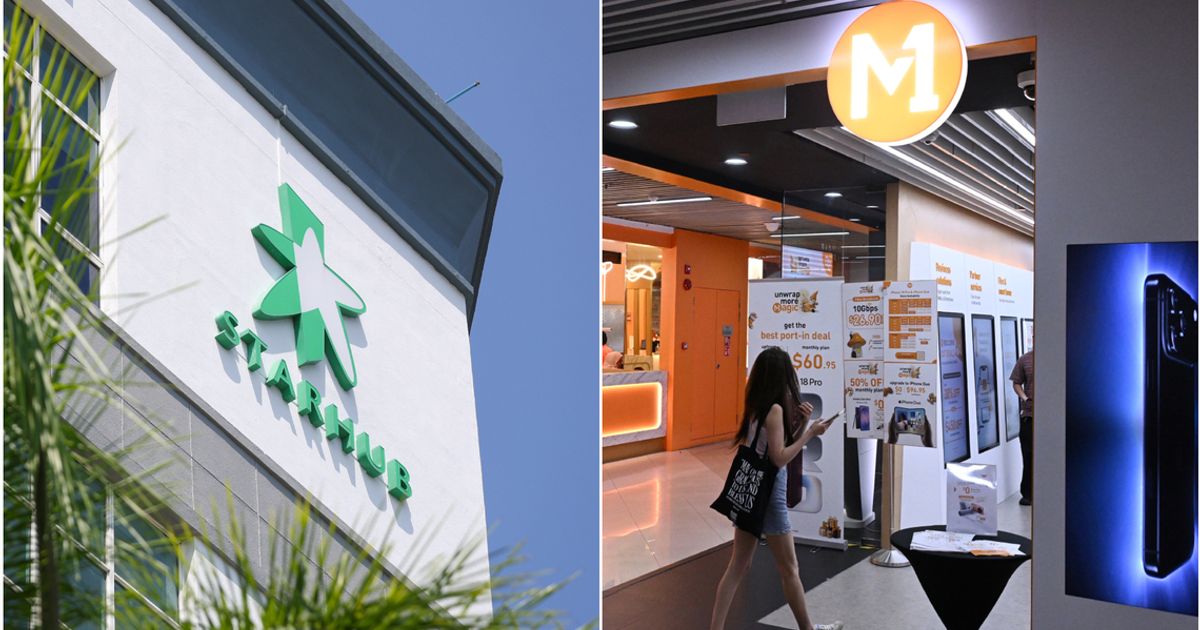
With the latest acquisition, major market disruptors Circles.Life, StarHub Giga, Eight and MyRepublic Mobile will be housed under the merged StarHub-M1 entity. It will need to compete with only two other full-fledged telcos, Singtel and Simba, in a far less crowded market.
Ironically, losing M1 benefitted Simba. It will become the only independent budget mobile operator left, easing the pressure to undercut rivals to survive. This is why investors rallied behind Tuas’ stock.
Singtel’s steady stock uptick reflects similar relief that industry-wide price erosion will begin to cool off.
Essentially, Singapore’s telco industry will be back to three dominant players, much like a decade ago, before regulator the Infocomm Media Development Authority (IMDA) awarded more licences to inject more vibrancy and innovation in the sector.
Specifically, in 2016, the IMDA paved the way for a fourth telco through a 4G airwave auction and facilitated the entry of mobile virtual network operators, which lease network capacity from established telcos rather than building their own infrastructure.
Circles.Life, Eight and MyRepublic Mobile are virtual telcos.
The shake-up was badly needed. Then, monthly mobile plans typically cost upwards of $20 a month with tight data caps of 2GB to 5GB, alongside punitive excess data fees of $10.70 a GB, with little variation across all three telcos Singtel, StarHub and M1.
Since then, generous plans at rock-bottom prices have flooded the market.
Today, M1’s Maxx sub-brand offers 500GB of 5G data (usable in Singapore and four other Asian destinations) for $10 a month. The plan also comes with 13GB of Asia-Pacific roaming and 3GB of global roaming.
Simba charges the same rate for similar perks.
Meanwhile, StarHub’s Giga sub-brand charges $15.90 a month for 300GB of data usable in Singapore and Malaysia, with an 8GB roaming allowance across five destinations in Asia.
These generous offers were unheard of in 2016.
Low prices are said to be unsustainable as they undermine profitability and long-term investment in network security and upgrades.
That said, these low-cost plans are unlikely to vanish overnight.
Until the merger completes in 2027, both telcos’ offerings will remain unchanged – this much StarHub has promised. Any price changes are subject to a public consultation, which will follow their merger submissions to the regulator on Nov 25.
Rather than a sudden price swing, expect a slow squeeze. Promotional data giveaways and cheap roaming add-ons will likely disappear first, with ultra-low budget plans quietly retired or repriced over time.
What are the upsides?
For everyday mobile users, consolidation can deliver tangible benefits – provided it is executed with customers, rather than just cost-cutting, in mind.
In StarHub and M1’s case, pooling more than 7,000 mobile equipment sites and 13,000km of fibre optic cables could deliver faster speeds and stronger indoor connectivity. Deployed and distributed well, a denser combined network may eliminate frustrating 5G dead zones during daily commutes on underground train lines or inside building basements.
Consolidation also opens the door to better digital service.
Streamlining duplicate billing and app systems – part of StarHub and M1’s larger plan to save $110 million a year – gives the merged telco a chance to plug existing gaps in billing and customer care.
Here, it can learn directly from Circles.Life, whose app pioneered self-service sign-ups, plan adjustments and bill payments at launch in 2016, and became the first in Singapore to bundle paid access to six popular AI models – including OpenAI’s ChatGPT, Google’s Gemini and Anthropic’s Claude – directly inside its app in 2025.
Finally, easing the race to the bottom should leave telcos with healthier financials to invest in network resilience and data security.
Cyberespionage group UNC3886’s attack on all four Singapore telcos, disclosed in February 2026, was a stark reminder that cut-throat price wars cannot come at the expense of cyber defences.
Even if the telcos had invested in robust cybersecurity defences, there is always room to do more with AI supercharging cyberthreats.
Regulatory safeguards
Larger scale and stronger balance sheets only create the potential for better service; standards could still slip. That is why consumers cannot rely on corporate goodwill alone.
As part of its merger review, IMDA has both the duty and the authority to attach binding safeguards that protect subscribers from higher prices and weaker service.
Ultimately, a merger between two major full-fledged telcos – StarHub and M1 – in a heavily regulated sector should not be treated like a standard free-market transaction.
This consolidation creates an overwhelming concentration of scarce premium radio frequencies in the hands of two giants: Singtel and the combined StarHub-M1 entity.
For instance, the entire block of premium 3.5 GHz radio frequency is split evenly between Singtel and the merged StarHub-M1 entity. Simba has zero holding, denying it the high-capacity highway needed for delivering fast nationwide 5G connectivity indoor and outdoor.
Sure, Simba can partially compensate for holding smaller blocks of spectrum by densifying its network, such as adding more base stations and small cells closer together.
While Simba’s parent Tuas has earmarked $50 million to $55 million in its 2027 financial year for ongoing network expansion, densification is slow and cannot match the raw speed advantage that comes with holding a large slice of the 3.5 GHz spectrum.
Such structural imbalance risks cementing a duopoly of Singtel and StarHub-M1, weakening Simba’s ability to keep prices in check.
To offset that reduced competition, IMDA could consider imposing a temporary freeze on mobile prices and data perks well beyond 2027 a condition for approving the merger.
This would be taking a leaf from Simba and M1’s earlier pledge to keep their popular $10 and $12 plans available to new customers, and freeze prices for existing users, for at least two years under their now-collapsed $1.43 billion deal.
Another possible measure to safeguard consumer interest is to require verifiable improvements in 5G coverage.
IMDA already enforces baseline 5G roll-out rules and penalises outages, but today’s baseline rules focus primarily on achieving outdoor coverage of 95%. There is a gap in 5G dead zones in underground train tunnels, lifts and building basements.
IMDA currently audits indoor coverage, requiring more than 85% signal coverage in buildings and more than 99% coverage in road and train tunnels. But the standards apply only to 4G networks.
With consolidation concentrating market power in the hands of two players, IMDA could establish binding minimum standards for indoor 5G coverage.
Another area that IMDA could look into is mandatory bill rebates if network integration triggers service disruptions. These currently depend solely on corporate goodwill.
When a three-day Singtel mobile outage in March affected 720,000 subscribers, the telco was fined $1 million. Although Singtel voluntarily handed out $5 to $10 goodwill rebates, costing it $8 million in total, such payouts remain optional. IMDA views voluntary compensation as a mitigating factor when determining fines.
The regulator also faces a delicate enforcement call over Simba, the only rival to the two giants.
Simba’s scuttled M1 deal followed a May regulatory probe into its unauthorised use of radio frequencies – allegations that the telco did not contest in a Tuas filing on the Australian Securities Exchange on Nov 17. Its Singapore-based director Richard Tan also resigned.
Simba is still awaiting IMDA’s enforcement decision, which could involve heavy fines or even the loss of its operating licence.
The regulator must deal firmly with spectrum breaches to protect the integrity of Singapore’s air waves. Yet any stiff penalty would clip the wings Singapore’s sole independent budget operator, leaving consumers even more exposed to the Singtel and StarHub-M1 duopoly.
It is a conundrum that makes binding consumer safeguards on the StarHub-M1 merger all the more essential.
A decade ago, market liberalisation broke a complacent triopoly where subscribers paid upwards of $20 a month for as little as 2GB of data.
As consolidation swings the industry back towards three, or effectively two, dominant players, IMDA’s task is to ensure Singapore does not slide back to higher prices, stingier plans and slower innovation.
-
Irene Tham is an assistant news editor and oversees tech coverage as The Straits Times’ technology editor. She writes regular columns that look at how technology is shaping the world.