KOBAR and MPR Urge Stronger National Dengue Prevention
Jakarta, IO — Dengue remains a major health challenge worldwide. According to the World Health Organization (WHO), half of the world’s population is now at risk of dengue infection, with an estimated 100–400 million infections annually. Indonesia ranks second globally in dengue burden after Brazil and first in Southeast Asia.
Climate change is intensifying the dengue threat, particularly in vulnerable tropical and subtropical regions, according to a systematic review of studies published between 2016 and 2025 in Southeast Asia.
Climate factors, including temperature, rainfall, humidity, El Niño, and La Niña, can accelerate Aedes aegypti mosquito development, increase virus transmission, and expand dengue’s geographical spread.
Climatological studies by the Meteorology, Climatology, and Geophysics Agency (BMKG) confirm that La Niña events, including the triple-dip La Niña phenomenon between 2020 and 2023, directly affected Indonesia by bringing the rainy season earlier than usual and increasing rainfall, which pose spiking the dengue cases.
These findings are supported by a 2024 study published in EnviroScienteae, based on data from 2007 to 2017, which found that moderate La Niña events, such as those in 2007–2008, 2011–2012, and 2013, significantly increased dengue cases by up to 67.6% across 23 provinces in Indonesia.
Higher rainfall extends the lifespan and resilience of Aedes aegypti mosquitoes, accelerating virus replication inside their bodies, and increasing biting frequency.
According to Ministry of Health data, Indonesia recorded 161,752 dengue cases between January and December 2025, with an incidence rate (IR) of 50.23 per 100,000 population and 673 deaths, representing a case fatality rate (CFR) of 0.42%.
Cases were reported in 475 regencies and municipalities across 36 provinces, while fatalities occurred in 224 regencies and municipalities across 31 provinces. This indicates that dengue has spread to 92% of Indonesia’s 514 regencies and municipalities.
Economic Burden Reaches Rp9 Trillion, with More Than 2 Million Hospital Admissions
Dengue is also a major national economic burden, placing pressure on healthcare financing systems, productivity, and household finances.
Research by the Center for Health Financing Policy and Insurance Management (Pusat KPMAK) at Gadjah Mada University (UGM), presented at the 9th Asia Dengue Summit in Singapore in June 2026, estimated that dengue imposed an economic burden of US$550.9 million, or nearly Rp9 trillion, in Indonesia in 2024, with more than two million hospital visits.
The UGM study found that most of the economic burden was associated with patients covered by BPJS Kesehatan through the National Health Insurance (JKN) program, with estimated direct medical costs reaching approximately Rp3 trillion.
This was accompanied by a sharp increase in dengue-related visits to primary healthcare facilities, from 122,000 to 321,000, representing a 162.8% increase. Meanwhile, total dengue-related spending at advanced healthcare facilities reached Rp8.1 trillion between 2021 and 2025.
Despite JKN coverage, households still face an estimated Rp3.5 trillion in nonmedical expenses, including transportation, meals, accommodation, and lost income during treatment.
2026–2029 National Action Plan Seeks to Strengthen Integrated Dengue Control
Climate change and the growing dengue burden highlight the need for a more integrated approach to dengue control in Indonesia.
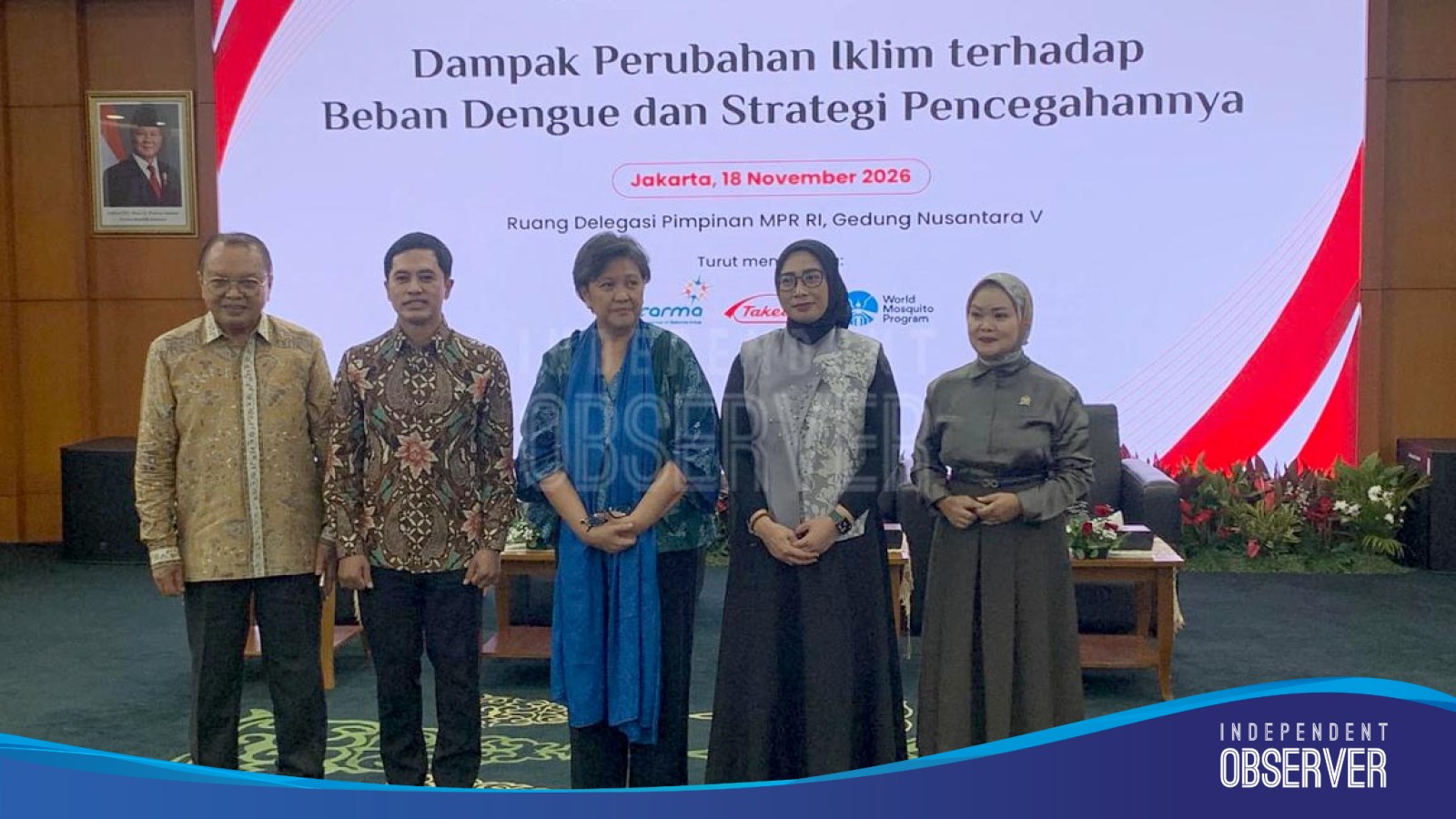
In response, the Joint Coalition Against Dengue (KOBAR Lawan Dengue), together with the Denpasar 12 Discussion Forum of the People’s Consultative Assembly (MPR RI), organized a policy dialogue focusing on the impact of climate change on the dengue burden and prevention strategies.
The event was the second installment of the Policy Dialogue on Dengue series. The first session, held on November 5, 2025, focused on the dengue burden and the importance of establishing an integrated reporting and early warning system through a One Data approach. The third session will address leadership, central and regional government coordination, and long-term financing.
Chairman of KOBAR Lawan Dengue, Dr. H. Suir Syam, M.Kes., M.M.R., said the policy dialogue was designed to go beyond technical discussions and serve as a strategic instrument for building policy consensus among stakeholders, including the government, academics, professional organizations, the private sector, and civil society.
“Through this network of stakeholders, we hope the dialogue will provide a foundation for further constructive discussions, bring together different perspectives, and strengthen the national action plan toward the target of zero dengue deaths by 2030,” he said on Wednesday (18/11/2026).
Deputy Health Minister Prof. Dr. Dante Saksono Harbuwono emphasized that dengue control requires innovation alongside community-based prevention efforts. “Dengue cannot be tackled by relying solely on community participation. We need more innovations in vector control,” Dante said.
Alongside existing control measures, technological innovations involving Wolbachia-infected mosquitoes and dengue vaccines are now available. However, he stressed that all interventions must complement one another.
According to Dante, Wolbachia technology must continue to be accompanied by mosquito breeding-site eradication through the 3M Plus campaign. He also warned that climate change, including El Niño periods, could create favorable conditions for mosquito breeding.
He welcomed the policy dialogue initiated by MPR RI and KOBAR Lawan Dengue, expressing hope that the forum would produce actionable policy commitments and recommendations that could be jointly followed up by the Ministry of Health and other stakeholders.
According to KOBAR Lawan Dengue, Wolbachia pilot programs are currently being implemented in Semarang, West Jakarta, Bandung, Kupang, and Bontang.
Meanwhile, limited dengue vaccination programs for children in specific age groups have been or are being implemented in 12 regencies and municipalities, including Balikpapan, Samarinda, Probolinggo Regency, North Minahasa Regency, Kutai Kartanegara Regency, Melawi Regency, Penajam Paser Regency, Bulungan Regency, and Sumenep Regency. Active monitoring programs for dengue vaccination are also underway in three cities: South Jakarta, Banjarmasin, and Palembang.
Dr. Ardhasena Sopaheluwakan, Deputy for Climatology at BMKG, also stressed the need to integrate climate and health data to ensure that prevention measures can adapt to local seasonal patterns.
“Therefore, by integrating climate and health data, we can implement adaptive dengue prevention measures tailored to local climate characteristics and disease patterns,” he explained.
Deputy Speaker of MPR RI Lestari Moerdijat underscored that dengue control requires cross-sector policy coordination, continuity between central and regional regulations, and stronger healthcare workforce capacity. “We consider the National Action Plan (RAN) for Dengue Control an important instrument to ensure that dengue control efforts are comprehensive, integrated, and sustainable.
“This forum seeks to encourage dialogue, strengthen coordination among stakeholders, and oversee our shared commitment to launching the 2026–2029 National Action Plan for Dengue Control. This will ensure that every strategy outlined in the plan translates into concrete, measurable, and targeted action,” she said.
Deputy Chair of Commission IX of the House of Representatives (DPR RI), Dr. Hj. Nihayatul Wafiroh, M.A., emphasized that stronger national dengue control policies must be accompanied by concrete prevention measures and sustainable financing.
“First, we must accelerate the adoption of the National Action Plan (RAN) for Dengue Control as a continuation of the 2021–2025 National Dengue Strategy,” she said.
She also highlighted the importance of mosquito breeding-site eradication through the 3M Plus campaign, the use of Wolbachia technology, and accelerating the introduction of dengue vaccination as a central government program.
“These three measures are complementary strategies, not alternatives to one another,” she added.
Private Sector Reaffirms Commitment to Comprehensive Dengue Prevention
As another important stakeholder in dengue prevention, the private sector also reaffirmed its support for comprehensive efforts to address the disease.
“Through today’s dialogue, Takeda, as one of KOBAR’s founding members representing the innovation sector, is also strengthening its commitment to dengue control in Indonesia. We are committed to supporting stakeholder efforts through education, the 3M Plus campaign, and innovation-based prevention measures such as vaccination. We believe that with a shared commitment among stakeholders to follow up on the dialogue’s outcomes through ongoing forums and coordination mechanisms, the goal of zero dengue deaths by 2030 is not merely an ambition but an achievable target,” said Simon Gallagher, Country Head of Takeda for Malaysia and Indonesia.
Professor Scott O’Neill, Founder of World Mosquito Program (WMP), also emphasized the importance of collaboration and science-based innovation in addressing the increasingly complex challenges of dengue control.
“From the outset, we have supported KOBAR Lawan Dengue’s role as a stakeholder network promoting collective action to control dengue. The launch of the 2026–2029 National Action Plan for Dengue Control represents an important opportunity to strengthen comprehensive, adaptive, and sustainable prevention strategies. We hope that evidence-based innovations, including Wolbachia technology, can become part of an integrated approach supported by cross-sector collaboration. This will enable us to build more resilient dengue control efforts,” he concluded.

